Mobile Devices shifting power to the users, away from IT departments

When I was visiting Mizzou last week, I was able to visit Clyde Bentley.  Clyde writes a blog on Mobile Journalism and the conversation with Clyde was quite useful to build future discussions on mobile devices and its effect on information publishing.

Below is a video of Clyde discussing the change in journalism caused by Mobile Devices.

Clyde Bentley: Why editors should make the move to mobile now from Bill Densmore on Vimeo.

And, what got me thinking more was this post on AgileOperations.

Agile Operations is a concept which combines lean, low-cost service delivery with flexible, just-in-time response to business demands, helping you keep your department relevant and competitive with trendy low-cost solutions available outside the business. In a sort of technology judo, Agile Operations seeks to use the strengths of these alternatives against them, keeping the flexibility and the savings in house and under the control of the IT department without resorting to heavy-handed prohibitions and lock-down measures which simply serve to force users further and further from a state of trust and understanding with the CIO.

This post on AgileOperations and Mobile discusses the impact on IT departments.

The challenge to the IT department in this scenario is to provision and support users with these devices and solutions. This is a far different prospect than traditional IT provisioning and support, and many IT departments are having trouble keeping up. It's not the first time IT has had trouble staying on the same plane as users when new technologies emerge, but this time, the devices and the online solutions are sufficiently cheap that those users don't need the IT department to implement them. While IT has held the keys to the kingdom for many years, there is an increasing chance that the IT department will simply become irrelevant as users bypass it for easier, cheapers solutions. As this Wall Street Journal article outlines, that day is coming.

We have all been frustrated with IT departments who standardize the desktop and laptops we use to reduce IT costs.  In Mobile, this is the strength of RIM's Blackberry server and the ability to manage the Blackberry device.  But, the rest of the industry is moving so fast, and managed mobile devices are not a priority for many.

I had a blackberry curve last year and now have an iPhone 3GS.  There is no way I would go back to a Blackberry device.  If anything I would try a Google phone.

Maybe one of the most rapid innovations and growth for Mobile's is the fact they are not in control of many IT departments.

How many of you think you would have a better mobile experience if your IT department made your purchasing decision?

Feel sorry for all those blackberry users who have a choice of one.  Unless you are an executive and you can get the more expensive Blackberry one with a touch screen.  Ooohhh!!!!

Read more

Sustainable Farming Method applied to Sustainable Data Centers, Dan Barber's entertaining how I fell in love with a fish, it's about relationships

This is a video that has 5 stars. It is entertaining, funny and educational.

Here is Huffington post article about the video.

Dan Barber: How I Fell in Love With a Fish

Chef Dan Barber squares off with a dilemma facing many chefs today: how to keep fish on the menu. With impeccable research and deadpan humor, he chronicles his pursuit of a sustainable fish he could love, and the foodie's honeymoon he's enjoyed since discovering an outrageously delicious fish raised using a revolutionary farming method in Spain.

Here is a picture of the fish farm.

image

Which is different than a typical fish farm.

image

One of the best lines that gives you the method, the secret to success in the sustainable farm is the biologist isn't an expert in fish, but is an expert in relationships.  If you go to time mark 8:10 you can listen to this.

Dan asks How did he become an expert on fish?

Fish??  I don't know anything about fish.  I am an expert on relationships.

Why is this so important?  Because the people who are doing the most innovative data center work understand the relationships of the site to the building to the IT equipment to the software and the services provided.  This is what good system engineers know in mature industries.  This is beyond the data center building with its power and cooling systems.  The enlightened are looking at the energy supply chain with a focus on cost, carbon impact, and changes in the supply chain in the future.  What is the future of services and applications that need to run on servers, storage, and networks.  This is one damn hard problem to address as the silos in data center are powerful and entrenched in a companies organization and the rest of the industry.

I just came back from Missouri and got a chance to talk in more detail to the Civil Engineering company, Allstate Consulting who is working on site analysis of the Ewing Industrial Park.  Over the past 9 months there are a variety of people who are being exposed to data centers who had no previous data center experience.  Yet, there are many instances of where potential site users are surprised on the engineering analysis and drawings prepared.

Having a pizza at Shakespare's Pizza in Columbia, MO, with Chad Sayre, VP of Design Services at Allstate Consulting.

Chad W. Sayre, PE, Vice-President

Mr. Sayre obtained a Master of Science and a Bachelor of Science in Civil Engineering from University of Missouri-Columbia.  Since 1994, Mr. Sayre has been a Project Engineer for Allstate Consultants.  In 2000, he became Principal/Vice President and Chief of Design Services for the firm.  He is responsible for municipal and land development engineering projects including forensic, water, wastewater, land planning, environmental compliance permitting, highway design, hydraulics, and stormwater projects.  He is closely involved with construction administration, inspection, specification preparation of public and private projects and has a considerable amount of experience in expert testimony.

He was telling the story of how he attended DataCenterDynamics conference and was in the bar (which is common networking method at all DataCenterDynamics event), and was telling a big data center customer, "A year ago, I didn't know shit about data centers." 

But, I'll tell you what Chad does know is the methane gas production issues from the adjacent land fill.  How the topography of the site can be used to create isolation areas to protect the site and change building design. How easy it is to dig trenches to connect to additional fiber. How BioMass can be used to generate renewable energy. How construction techniques that have been applied to multiple other industries can be used in manner similar to what Microsoft has proposed.

These facilities will not be pretty and might actually resemble the barns I spent so much time around during my childhood in rural Illinois. That, combined with the fact that these facilities will be substantially lower cost per megawatt to build and substantially lower cost to run, makes it very easy to become excited about what we’re doing here.

William Gibson said it best: “The future is here, it’s just not widely distributed yet.”

When you look for who knows how to build sustainable, green, low carbon data centers, look for those who understand relationships.  I am tired of hearing people tout their latest hardware as the answer to the problem, but they can't explain how this new equipment effects the rest of the system.

It would be pretty damn funny, but almost impossible to create a video like Dan Barber did for "How I fell in love with a Data Center"

Actually, I do know lots of people who fell in love with their data centers.  But many times it is more like this image, high density, low PUE, with little discussed on the carbon impact or waste.

image

Wouldn't it be cool if data centers could help the environment?

image

Read more

Bill Gates has the data for connection between energy and climate, sees opportunities for Gates Foundation and his own money - Terrapower

Bill Gates recently presented at the TED conference.

image

His video is below and it is 30 minutes long so I know most of you will not watch the whole thing.

There are a few things I learned from his talk that most will miss.  I've been in a variety of BillG meetings while at Microsoft and have watched from the inside and outside how Bill operates.

One funny story I used to tell ( the story is over 10 years old) is a BillG keynote at Seybold Seminars.  This was back in late 1996-1998 when Bill wanted Windows to win the battle for desktop publishing.  He wanted the data on what Microsoft needed to do to win vs Apple.  Seybold Seminars no longer exist, but here is bit of background.

Jonathan Seybold sold the company, and various successors ran the conference into the ditch, with the seminar, once the biannual gathering of the print tribes, disappeared a year ago. Jonathan was the oracle of desktop publishing, whose late-80s mantra ("standard platforms, shrink-wrapped software") set the direction for desktop publishing, and, later, the open source movement for all content production.

I had researched the topic before the event and collected detailed notes on Apple and Adobe's presentations to prepare Bill for his keynote.  I also prepared discussion material for Jonathan Seybold visited Microsoft for a Bill Gates meeting and sat in the meeting.  Bill is a data driven guy and the night before his keynote the rehearsals was a data driven discussion on what to discuss.  There were at least eight Microsoft guys surrounding Bill as he practiced his presentation and asked for clarification or more data.

Where was I?  200 ft away in the audience sitting with the Seybold Seminar event staff, five women I was joking with watching the Microsoft guys jockey to get a word in.  I figured out a long time ago, there was not a huge upside to getting in front of Bill.  It's not like he says "great job Dave, here are more options."  But, he can say "that's f*** stupid." and you now need to fight your point to prove Bill is wrong or admit Bill was right and I am stupid.  How much fun is that? Vs. sitting with five women for 1 1/2 hrs having pleasant conversations.  Also, one of the five is now my wife.

I tell this story, because I look at Bill's speech from a different view.  So, back to what I saw in Bill's speech. 

  1. Bill has the data that shows the same people he is trying to help with health initiatives at the Gates Foundation are impacted to a greater degree by climate change and availability of energy. (seemed kind of obvious to me)  If there is a drought caused by global warming, then crops and water supplies are effected for the population.  This is explained in the first minute above video.
  2. The cost of energy has the most impact on the poor.  Here is a graph of the price of energy.image
  3. He has a simple formula. The sum of CO2 increases temperature has a negative effectimage
  4. Bill asks his scientist.  Can't we just reduce carbon to solve the problem.  His scientist say until CO2 from energy generation hits zero the temperature will continue to rise. image
  5. Bill next goes into what can be done to get to zero.  Asking the question can any of these go to zero.  Walks through each the conclusion is C02 per unit energyimage
  6. What Bill says is we need Energy Miracles that are cheap and no CO2.image
  7. Bill identifies the areas he think miracles can be done. image
  8. Bill makes this excellent point on energy storage.  All the batteries on the earth only store 10 minutes of energy.image 
  9. Then he gets to his answer for a miracle. Terrapower a travelling wave nuclear reactor.image
  10. And last, Bill appeals that there are many things that need to be done to reach the goal of 1/2 cost power with no carbon.image

One other big point that was made after Bill was presenting when discussing Terrapower.


Intellectual Ventures® investments in energy inventions have evolved to become TerraPower, an expert team that is investigating innovative ways to address energy needs. TerraPower’s most advanced work centers on radically improving ways to make electricity using nuclear reactors.

At minute 21:10 in the video, the question is asked where Terrapower and Bill's team is discussing who to work with.  The answer is China, Russia, and India.  Conversations with US Secretary of Energy are mentioned as well, but I can imagine the regulatory and political activists issues in the US have Terrapower seriously looking at countries outside the US to develop the technology.

On my next trip to Missouri I hope to get a tour of their nuclear reactor, and maybe I can ask them if they have had any discussions with Terrapower.

Here is a presentation by Terrapower's John Gilleland.

“The TerraPower Initiative”

presenter:

John Gilleland

Organization:

TerraPower LLC

Gilleland

video:

Click here to watch a recording of the talk

TerraPower, LLC is a privately funded initiative focused on the development of a new reactor and simplified nuclear infrastructure. Objectives include (1) reduction, and eventual elimination, of the need for enrichment facilities; (2) elimination of any future need for chemical separations-based reprocessing facilities; (3) utilization of natural or depleted uranium as fuel; and (4) achievement of a COE competitive with clean coal plants. Participants include 65 individuals from UC Berkeley, MIT, UNLV, ANL, Burns & Row, CBCG, and Intellectual Ventures.
The reactor is based on the travelling wave concept. The speaker will review the concept and discuss the development challenges.

Thanks to some friends at Intellectual Ventures, I have contacts at Terrapower, but Terrapower Nuclear power generation is decades off, and I can take my time until I have more data.  :-)

Read more

My Inspiration for Networking, my son

Going to data center events are great ways to network.  And, honestly I learn very little from the presentations, other than different ways to present the same material or how slow progress is being made in the data center industry.  I learn 10x times more as I talk to others before, during and after the events.  I am driven to network to learn.

When I was young, I was one of the smallest and quietest kids in class.  I was introverted, and it is easy to go back to an introverted mode as I think and research topics.  Thinking of things by myself is easy.  But, there is so much more you can do when you work with others.  I left Microsoft 4 years ago after 14 years mostly working on Windows.  Microsoft has an immense network inside and outside the company.  I needed to create a new network to work on some new ideas.  I didn't want to start a company with employees, but I like developing innovative solutions.

Some people join other companies right away, but I took a year off to think about what I wanted to do. and started the green data center blog as part of a way to research the topic and socialize ideas.

When I left Microsoft my son was 2, and will be 6 next month. He has a special gift of networking, a talented extrovert.  Socializing is natural for him, allowing him to build a large strong network.  He can play sports with 3rd graders, the 5th grade girls think he is cool, and he makes high school kids laugh.

How good is he?  He is in kindergarten, and he is one of the most popular cool kids at school.  Yes, we have had many parents warn us we are going to have interesting challenges given his social skills and popularity.

On his own he wanted to be in the school's talent show.  He is in kindergarten and wants to solo perform in front of the school.  He has his own idea of what he wants to do, makes up his own dance, and won't listen to any help from his mom who is a talented dancer.  He's got his own vision.

How popular is he?  He gets applause and people call out his name when he walks on stage, receiving more attention than most get after they perform.

image

He's been practicing his moves.

image

His smile is natural and effective.

image 

He knows how to create intensity.

image

And finishes with a bow, then another, and another as the crowd claps.

image

I can't even come close to what my 5 year old can do, but I keep on trying to learn from his natural talent to network.  :-)

Read more

Flaw in Data Center Site Selection, one number vs. range of performance approach

I was just talking to some folks about data center site selection and the method to create a long list of criteria, create weightings, multiple the numbers, add the scores, then select the highest score as criteria site selection is flawed.

The flaw? Thinking that the weightings are the right numbers and the criteria can be counted as independent factors.

First one, weightings help prioritize those factors that are more important to the business.  This creates a single number.  Problem is business changes, and not all businesses can be represented by a single number.

Right approach, data center sites should be characterized by a range of performance that support the range of business now and in the future.  The sites that should be scored highest are the ones that best suit the range of performance for the business, not the highest score.

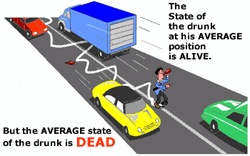
The error of a single number view vs. the range can be illustrated by the "Flaw of Averages."

The Flaw of Averages
A common cause of bad planning is an error Dr. Savage calls the Flaw of Averages which may be stated as follows: plans based on average assumptions are wrong on average.

As a sobering example, consider the state of a drunk, wandering around on a busy highway. His average position is the centerline, so...

Second one.  The criteria listed are assumed to be independent factors, but most criteria have relationships to other things, and the interaction of criteria creates good and bad conditions that experienced people know, but the site selection so-called gurus think they can solve the problem with enough criteria and weightings.

For the amount of money spent on data centers over the lifecycles, data center models should be built.  The trouble is few companies know how to do this as it requires a holistic view,bridging site, data center building, IT hardware, and software. This is problem worth solving.

Read more