Electricity for a Data Center from Hamsters or Biomass, Missouri Senator Kit Bond votes for Biomass

I just got back from a long 5 days in Missouri, (Mi zoor ah).  Mi zoor ah is in general the pronunciation used by the Republicans in the state and Mi zoor ee is by the Democrats.  Senator Kit Bond is a highly recognized Republican in the state.

"Serving Missouri has been my life's work. I have walked the land, fished its rivers and been humbled by the honesty and hard work of our people. The highest honor is to receive and safeguard the public trust" - Kit Bond.

Christopher S. "Kit" Bond is a sixth generation Missourian, born in St. Louis in 1939. He grew up in Mexico, MO, where he still resides and tends to several groves of trees he planted by hand.

I was on a panel right after Senator Kit Bond's keynote presentation on renewable energy and data centers.  I met the Senator and discussed the idea of the "grass fed data center" fueled by Missouri Biomass.

Below is a video that gives you an idea of the Senator's vision. 

Senator Kit Bond discusses the potential of using Biomass to fuel data centers in Missouri which is getting traction with a lot of potential potential clients as the Senator mentions.

Soon there is going to be a biomass powered data center and with efforts like Senator Kit Bond the momentum continues to build.

One of the humorous parts was the Senator making the point the Internet is not powered by hamsters.  But if you had few billion of these little guys you might get close to a megawatt of power.

Read more

A more enlightened approach to change

To Green the Data Center with lasting sustainable value requires change.  Measuring PUE adds a metric.  Meeting a LEED certification creates a requirement.  Small changes are made to accommodate these needs.  But, many times there is not a fundamental change.

Why change?  Because, if you don't change you do the same things you have done in the past.  Many learn to change labels of what they do, picking up new acronyms and buzz words, but don't fundamentally change.

So, if you are going to change you can take the approach of pick your number, define a timeline, make a plan, get a budget, execute, promote how you were successful, but ultimately fail in making a lasting change that feels good.

Why?  Because you weren't open to ask the tough questions.  You went for the easy answers.  A lower PUE and a LEED certification.

Twitter's Kevin Weil put it well.

image

If you want to change, think about how to ask the right questions.

I think most people are changing to conform to accepted changes.  It's safe.  Which brings up an issue of whether conforming to norms is consider change?

If you want to change to be more competitive you most likely want to innovate.

Are you changing to innovate or changing to conform?

Read more

Facebook is the Poster Child for Carbon in the Data Center Industry

Facebook has 0.5% of the installed base of Servers in World, hosted in about 10 colocation sites mainly in Santa Clara and Ashburn, VA.  Google and Microsoft have more servers in more locations, but Greenpeace and other environmentalists don't find these companies nearly as interesting.  Facebook represents its perception to media like OregonLive.

Q: Right after you announced your plans, Greenpeace and others chimed in about your power source (which includes PacifiCorp coal power). What did you learn about people's perceptions?

Jonathan Heiliger: In some respects it shouldn't be surprising, because we are a growing company and have become a fantastic target for people. That being said, we didn't explain well enough how efficient this site is relative to our current sites (Facebook currently leases data center space from other companies).

Facebook's new North Carolina Data Center is covered by the top technical news with many business journals and regular media picking up the news.  Keep in mind what media is after is traffic.  This isn't big news, and probably more news than Facebook wants as this type of news doesn't provide much business value to Facebook.

image

But this is enough news that Facebook's data center executives are in "damage control" of negative PR and Greenpeace is the top cause of the damage.

GreenFudge.org asks a good question.

Dirty coal and Green on Facebook. What’s the deal? And what should we do about it?

Posted by Murielle in Climate & Change, Science & Technology, Sustainable living, 2 minutes ago, 0

Recently Facebook launched their Green on Facebook page in an effort to green up their image after the big dirty coal data center debacle of earlier this year. According to their Facebook page, the Green on Facebook is

run by Facebook and will highlight our efforts to be a green and sustainable global citizen.

facebook dirty coal greenpeace 300x225 Dirty coal and Green on Facebook. What’s the deal? And what should we do about it?

Image by Library of Congress (source: Flickr)

Together with 56.000 others, I became a fan op the page, and as many others I’m sure I’m pretty disappointed with the content of it. The wall is filled with links to various articles about different environmental topics, but very little information is available about Facebook’s own efforts to be sustainable and green. One article, supposedly from Facebook’s own engineers, discusses the topic of cooling strategies in data centers to increase energy efficiency. I could not stop but wonder if this post has anything to do with the new dirty coal scandal that Facebook is looking at today.

According to Jodie Van Horn, blogger for Greenpeace, Facebook has chosen a new data center location near Forest City, North Carolina that will – again – increase the demand for dirty energy. Greenpeace energy campaigner Gary Cook issued the following statement about this news:

Facebook is becoming a vehicle and poster child for change.

So yes what Facebook is doing is not OK. Greening up their image and at the same time opening a new coal fueled data center. But let’s not kid ourselves, every time we surf the web we are pushing CO2 into the air. And in this story as in any other, we are the customers.

So what should we do about it? Get off the Internet as long as it’s not sustainable? That’s one option but maybe not the smartest one. A better idea might be to make more conscious choices, on and off the Internet, and to become aware that no company, organization or corporation will ever change their ways before we do. So in the end, or for starters, even if we don’t stop using Facebook (which we should eventually do, but hey we’re all human), a good step might be to sign up for Greenpeace’s Unfriend Coal campaign, as long as we understand that signing a petition now and again is not our way to carbon free heaven. It’ll take much, much more than that to get there.

BTW, all this noise and issues with Carbon in Data Centers makes it much easier to discuss Green Data Centers.

Go Facebook!!!

Keep on telling the environmentalist your PUE, LEED building certification, energy efficient servers and your chiller-less cooling system.

People will learn these technical data center details are not what the public cares about.  You can't change world talking about your Hadoop implementation.

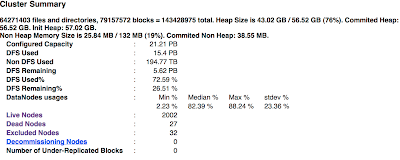
Facebook has the world's largest Hadoop cluster!

It is not a secret anymore!


The Datawarehouse Hadoop cluster at Facebook has become the largest known Hadoop storage cluster in the world. Here are some of the details about this single HDFS cluster:

  • 21 PB of storage in a single HDFS cluster
  • 2000 machines
  • 12 TB per machine (a few machines have 24 TB each)
  • 1200 machines with 8 cores each + 800 machines with 16 cores each
  • 32 GB of RAM per machine
  • 15 map-reduce tasks per machine

That's a total of more than 21 PB of configured storage capacity! This is larger than the previously known Yahoo!'s cluster of 14 PB. Here are the cluster statistics from the HDFS cluster at Facebook:

Read more

The Greenest Data Center Dynamics London Conference

I was fortunate to sit on a panel with Stephen Worn.  Stephen came to St Louis straight from London to present on the convergence of renewable energy and data centers.

Here is Missouri Senator Kit Bond with Stephen discussing Green/renewable energy data centers.

image

DataCenterJournal reports on DCD London.

Color London Green

THURSDAY, 11 NOVEMBER 2010 05:52

WRITTEN BY RAKESH DOGRA

E-mail Print PDF

For any entity or individual wanting to explore the realm of the green data center, London was a center of information.
DatacenterDynamics 2010 was held earlier this month at the Lancaster Hotel in London and featured experts like Derek Webster, head of data center development with Yahoo; Raimo Peres, vice president of Deutsche Bank; and many other luminaries. The conference considered areas like energy efficiency, cloud computing and virtualization, capacity planning, technologies like free cooling and UPS design innovation, and so on. One of the major focus areas was the Carbon Reduction Commitment. The U.K. government recently stated that it does not intend to reallocate the collections made from the carbon reduction tax. This issue was debated extensively at the DatacenterDynamics event.
The emphasis on green IT was apparent in many of the addresses given by various industry leaders. For example, George Adams, Engineering Director with SPIE Matthew Hall, spoke about Project Merlin, which produced a low PUE design. Two senior-level ABB executives discussed the Carbon Reduction Commitment.

Note this news on the Carbon Reduction Commitment tax.

About 81% of the respondents to a survey conducted by DatacenterDynamics stated that they were concerned about the ambiguity surrounding the Carbon Reduction Commitment tax. In the same survey, almost half the respondents also felt that this tax could drive data center investment out of the U.K.

I wish I could be at DCD London, but Stephen did come to St. Louis and we had a good catching up over awesome steaks and wine at Annie Gunn's.

Annie Gunn's is known for its' heartwarming, nurturing, robust dishes that encourages us through another gloomy St. Louis winter.
Read more

US companies building Data Centers in other markets

US based companies build some of the biggest data center portfolios in the world.  The rate of expansion in markets outside the US will grow faster than the US data center market.  Digital Realty Trust announced their Asia expansion.

Jim Smith, chief technology officer (CTO) of the U.S.-based Digital Realty Trust, said the company had been thinking of entering the region earlier in 2008, but the recession in the latter half of that year proved to be a "distraction". Since then, many of its existing customers have been after the datacenter operator to branch out into this part of the world, he noted.

The CTO, who was in town for a conference, told ZDNet Asia during an interview Thursday that as Asia-Pacific has not experienced the "datacenter boom-and-bust" cycle that afflicted the U.S. during the dotcom years at the turn of the century, there are no legacy IT systems to contend with.

Furthermore, there is pent-up demand for more datacenter space and capabilities as companies in this region got out of the 2009 recession pretty quickly and are growing fast, he said. Increasing interest in cloud computing and virtualization technologies by businesses here are the other demand drivers mentioned by the executive.

To address the demand, Smith named four countries, namely Singapore, Australia, Hong Kong and India, which the company will be looking to work out of. Elaborating, he noted that Digital Realty Trust focuses on financial centers globally and has a presence in cities such as London and Paris. The Asian markets that the company is targeting are a natural extension of its business strategy, he said.

HP announced their 6 Global Service Hubs.  IBM has their international strategy.

Yahoo announced its Switzerland data center.  Many have gone to Dublin.

It will be interesting to see what plays out in Asia.  One huge advantage HP and IBM have vs. a Digital Realty Trust is their hiring of thousands employees in the country.

Just like any smart data center site selection process looks at the tax incentives.  The tax incentives for international are important.  HP has the tax incentives for its Malaysia global cent. 

CIO.com: Although these six hubs are not all new to HP, you will be staffing up in these locations. How many and what types of professionals are you hiring in each country?

Rasmussen: We did have a presence in these hubs already, but not at the scale we currently have or with the government approvals and tax benefits. We are aggressively hiring and building them out today. We don't disclose [employment] numbers at the location level or the "best shore" level.

Those who only want data center space like Digital Realty Trust are at a disadvantage to companies like HP, Google, and IBM that can negotiate with their local employee numbers which creates the support for the data center build out.

A more sustainable/green data center strategy requires understanding the environment., not just the environmental issues in an Asia country which includes the social, economic, and political issues.

Growth outside the US is huge.  Many of my best friends are people I worked with on developing products for Asia markets and purchasing products/services from these markets as well. 

Many people fall in love with a culture and want to immerse themselves in it and try to be a local, adopting local customs and business methods.  One good friend in
Japan said you are good at knowing the Japanese, but your advantage is you don't care about doing things the Japanese way, you just want to do the right thing.  They can't control you by telling you, "Sorry Ohara-san we just don't do things that way here."  which gets most Westerners to back off.

One of the funniest things to watch was big 6ft 5in Americans talk Japanese like a woman as he takes Japanese lessons at work from a woman who doesn't do business in Japan.  if you never knew there are gender differences in speaking Japanese.

Gender differences in spoken Japanese

From Wikipedia, the free encyclopedia

The Japanese language is unusual among major languages in the high degree to which the speech of women collectively differs from that of men. Differences in the ways that girls and boys use language have been detected in children as young as three years old (Tannen).

Such differences are sometimes called "gendered language." In Japanese, speech patterns peculiar to women are sometimes referred to as onna kotoba (女言葉, "women's words") orjoseigo (女性語, "women's language"). The use of "gender" here refers to gender roles, not grammatical gender. A man using feminine speech might be considered effeminate, but his utterances would not be considered grammatically incorrect. In general, the words and speech patterns considered masculine are also seen as rough, vulgar, or abrupt, while the feminine words and patterns make a sentence more polite, more deferential, or "softer" (countering abruptness). Some linguists consider the rough/soft continuum more accurate than the male/female continuum – for example, Eleanor Harz Jorden in Japanese: The Spoken Language refers to the styles as blunt/gentle, rather than male/female.[1]

There are no gender differences in written Japanese (except in quoted speech), and almost no differences in polite speech (teineigo), except for occasional use of wa (and except for the fact that women may be more likely to use polite speech in the first place).

I get around this whole issue when I was in Japan by never speaking Japanese.  I learned on my first trip to Japan in 1987, speaking Japanese doesn't work for me as the people expect my Japanese to be perfect because I look so Japanese.

I should think of these old Asia trip stories more, they are funny. Smile

Read more