Nathan Myhrvold says #1 problem is we need more power

WSJ has an interview with Nathan Myhrvold at the ECO:nomics conference.  I read the article this morning and was thinking whether to post or not, but then I ran into Nathan an hour ago and said hi.  How can I not take it as a sign to post given I hadn’t seen Nathan for???  I can’t remember how long it has been. 

Nathan makes an interesting point in the article that it is hard to argue with.

MR. MURRAY: You've done a lot of work in the energy area. Can you talk about where you're focusing your effort there?

MR. MYHRVOLD: The single biggest problem we have to focus on in this century is how to get every citizen of Earth roughly the same per-capita energy we enjoy in the developed world. China is developing. India is developing. Brazil is developing. They all want the lifestyle we have. The world's energy problem is about how we expand our energy budget by a factor of 10 or more, and short of incredible disaster or war, I don't know how we stop that.

We don't have any viable way to do it. I don't believe that problem can be solved with any combination of existing technologies.

Can you imagine a world where every citizen has roughly the same per-capita energy?  That is a tough problem.

MR. MURRAY: Do you have another idea that can reach that kind of scale?

MR. MYHRVOLD: We're trying, but don't just bet on me. The way we're going to solve this problem is the way we've solved all of the great technological problems like this in the past, which is you get a lot of people innovating.

Although the bigger news about Nathan is his new $462 cookbook.

Cook From It? First, Try Lifting It

Ryan Matthew Smith/The Cooking Lab LLC

The long-awaited “Modernist Cuisine” is a visual roller coaster through the current world of food and cooking tools. More Photos »

By MICHAEL RUHLMAN
Published: March 8, 2011

DESCENDING this week on the culinary scene like a meteor,“Modernist Cuisine: The Art and Science of Cooking” is the self-published six-volume masterwork from a team led by Nathan Myhrvold, the multimillionaire tech visionary who, as a friend of mine said, “decided to play Renaissance doge with food.”

Facebook and Google influencing Networking Technology faster than Telco ecosystem can react

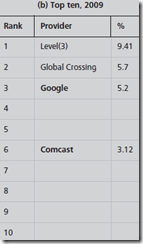
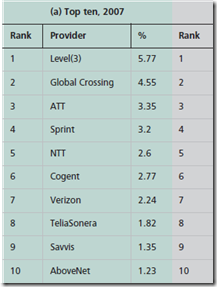
The landscape of Telco is changing.  Fast.  In 2007 the Internet traffic looked like this.

image

In a Google paper they said hey look at 2009.

image

In 2011, Facebook and Google are both in the top 10 and growing faster than the rest.  Light Reading has an article on this trend.

OSA 2011: Optical World Faces Hipster Challenge

MARCH 8, 2011 | Craig Matsumoto | Post a comment |

LOS ANGELES -- OSA Executive Forum 2011 -- The needs of content providers such as Facebookand Google (Nasdaq: GOOG) are starting to influence roadmaps in optical components and systems, and that's accentuating the differences between telcos and new network owners.

Google makes the case that the traditional Telecom cycle is too slow which reminds me of the old way of product design.

Google's case was particularly spotlighted, partly because the company landed two panel spots (both filled by Senior Network Architect Bikash Koley, due to a colleague's illness). Koley made it clear that he thinks the traditional telecom cycles are too slow for Google and don't produce the right kinds of products anyway.

Google makes the point of the power consumption being too big.  How many network guys/gals do you know discuss the power of the network?  Networks have a big role in a green data center.

That's because standards too often aren't developed with the input of the ultimate buyers, he said. By the time products arrive, they're too big and/or power-hungry to suit the next-generation needs that the user is building for. Koley stepped through an example of how it all goes wrong, drawn not from Google but from his experience at a large equipment vendor. (He didn't specify which one, but his resume includes time at Ciena Corp. (Nasdaq: CIEN))

The users (Google and Facebook) are frustrated.

The problem stems from each vendor taking its cues from a neighboring step in the supply chain, rather than going to the source. The result, in Koley's example: A product that arrived years late. "Not talking to a user gives you the wrong time horizon," Koley said.

And, they are doing something about it.

One alternative is to bypass the standards bodies and develop a multisource agreement (MSA), a tactic that's worked for transceiver modules.

"Any time there's a void and there's enough need, especially if there's enough bandwidth that needs to be deployed, there's a vehicle" thanks to MSAs, said Donn Lee, a senior network engineer at Facebook. (Lee appeared on a panel separate from either of Koley's.)

Need evidence of how this might work? Koley pointed to the recently ratified 10x10 multisource agreement (MSA), which was created with input from a spectrum of companies including not just module suppliers, but also cable operators, telcos, Ethernet service providers and Google.

Here is the 10x10 MSA referred to above.

The 10x10 solutions is designed to meet the needs of users who need to go beyond 100 meters but less than 2 km.  Many data centers have link requirements beyond 100 meters, but don’t need to go much more than a few hundred meters.  The 10km solutions for these applications is overkill because the 10x10 solution can meet the link requirements at less than half the cost of 100GBASE-LR4 and about 70% of the power (14W for 10x10 vs 20W for 100GBASE-LR4).  Since the 10x10 is CFP compatible and can fit in the same port as 100GBASE-LR4, customers will see the benefits of the 10x10 over 100GBASE-LR4 for link distances over 100 meters but under 2 km.

Responding to the call by end-users and equipment manufacturers, the 10X10 MSA is established to deliver the industry’s lowest cost 100GbE solution over single-mode fiber.

The 10X10 MSA is defining a new price and performance trajectory for 100GbE that will significantly accelerate the adoption and economics of 100G deployments.

The 10X10 MSA group is backed by a robust ecosystem of end-users, system manufacturers and optical module suppliers including Google, Brocade, JDSU and Santur.
Member companies include Google, Brocade, MRV, Enablence, Cyoptics, JDSU, AFOP, Santur, Oplink, Hitachi Cable America, AMS-IX, EXFO, Huawei, Kotura, FaceBook, Effdon, Cortina Systems and BTI systems… Read More >>

Nimbula announces ship date for Cloud Operating System and partner ecosystem

Nimbula annouced it is ready to ship within 30 days.

Nimbula Announces General Availability of Cloud Operating System Software and Free Version

Santa Clara, CA – March 8, 2011 – Today at the Cloud Connect Conference, Nimbula, the Cloud Operating System Company, announced that its flagship product, Nimbula Director, will be generally available within the next 30 days.

Based on Nimbula's Cloud Operating System technology, Nimbula Director delivers Amazon EC2-like services to both enterprises and service providers. Allowing customers to efficiently manage both on- and off-premises resources, Nimbula Director quickly and cost effectively transforms inflexible, inefficient and under-utilized data centers into powerful, easily configurable compute capacity while supporting controlled access to off-premise clouds.

And, they have launched a partner ecosystem with the following companies signed on.

Citrix Systems, Inc. is a leading provider of virtual computing solutions that help companies deliver IT as an on-demand service. Cloud Cruiser

Founded in 2010, Cloud Cruiser is a venture backed company that provides cost optimization solutions for the rapidly evolving enterprise cloud.

enStratus is a cloud infrastructure management solution for deploying and managing enterprise-class applications in public, private and hybrid clouds.

Opscode is the leader in cloud infrastructure automation and provides the Opscode SaaS Platform, a widely used hosted service for configuration management and infrastructure automation.

Puppet Labs develops and commercially supports Puppet, the leading open source platform for enterprise systems management. With millions of nodes under management and thousands of users, including Twitter, NYSE, Zynga, Genentech, Match.com, eBay, NYU, and Oracle, Puppet standardizes the way IT staff deploy and manage infrastructure in the enterprise and the cloud.

Scalr is an open source cloud management tool. It is focused on scalability for web applications, with hybrid clouds, mysql failover, automatic load balancing.

There are fundamentally two choices out there.  One go to one company for your cloud solution – VMware, IBM, HP, etc.  Or a best of breed approach for your environment.  Nimbula for those who want to design and engineer their cloud environments.

Now that Nimbula is close to ship, we’ll see who adopts this approach.

China and Taiwan’s #1 Telecom companies join efforts in Cloud Computing between countries

Chunghwa Telecom (Taiwan’s #1 Telecom) and China Telecom (China’s #1 Telecom) have signed an agreement to deploy Telecom services in Western Taiwan to support Cloud and Smart Grid services between the countries reports Taiwan Economic News.

Chunghwa Telecom, China Telecom Co-Tap Coastal Economic Zone Market

2011/03/07

Taipei, March 7, 2011 (CENS)--Chunghwa Telecom Co., Ltd. and China Telecom Co., Ltd. recently signed an agreement to jointly deploy telecom services including intelligent energy management and cloud-computing networks on the Western Taiwan Straits Economic Zone, which mainly lies along the cost of the Fujian Province of mainland China.
The two telecom carriers vow to cooperate on the two telecom services across the mainland starting from the said zone, which was proposed by Chinese central government to integrate the economies, transport, infrastructure, policies from the coastal cities west of the Taiwan Straits for competitiveness, social development, increased and strengthened economic cooperation with Taiwan

The cooperation supports expanded services and cost reduction.

Chunghwa Telecom executives pointed out that the two companies will integrate their networks, distribution channels, products and technologies to explore business opportunities on the zone, with cooperation covering cloud computing, Internet Data Center, intelligent energy management, electronic commerce and energy saving services.

China Telecom Chairman Wang Xiaochu pointed out that the cooperation will help the two companies pare down cost for operations on the zone.

Twitter follows Facebook, both are looking for Server HW Supply Chain Managers

I posted about Facebook looking for a Manager of supply chain operations for server hardware.  The job posting is still open.

But, there is a bit of competition as Twitter also has a job posting open for a Technical Supplier Negotiator (Datacenter Hardware).

About This Job
Do you like to build data center infrastructure? Hardware Operations is looking for an experienced and self-motivated person to help build out Twitter’s growing data center compute power. We’re looking for someone to lead the supply purchasing processes. You should be comfortable working at both the tactical and strategic levels.
Responsibilities

  • Lead the purchasing strategy and execution for hardware
  • Own the total supplier relationship for Twitter’s supply base  
  • Lead all supplier negotiations and execute supplier contract agreements
  • Drive continuous supplier improvement performance programs

If you were qualified for this job would you rather work at Facebook or Twitter? 

One of the biggest problems with a person taking the job at Facebook or Twitter is you would most likely be the one person who does this job, and you don’t have peers to work together with.  There will be support people, and internal customers, but there are logistics expertise is not common in Internet companies.

Why is this an issue?  In my early days I was a distribution logistics engineer at HP, but the only one in the division.  Others who I could discuss ideas with were in other divisions, not my division.  Compare this to being a distribution logistics engineer at UPS or FedEx where there are many times dozens of people with this job role.  For the same reason groups can out innovate the most experienced individual, there are risk to be the only person working in a role.

This role should possibly be outsourced in addition to an internal hire.  Where?  A company that could help out a supply chain manager is Redapt.   I think it is time to go have beers with the Redapt folks at Black Raven Brewing and have discussion on this idea.

image

Someone asked who is Redapt?  Here are quotes with some customers.

Zynga

From start to finish, Redapt made our project a success by introducing innovative technologies and delivering fully integrated racks ahead of schedule.

Mark Stockford, VP of Production Operations, Zynga

Online "E"tailer

Redapt addresses our needs and finds the best solution to our problem. They have proven to be a true partner who really cares about our needs and expectations. We look forward to partnering with them in the future.

Client, National Sporting Goods Retailer

IBM

Redapt is fearless in finding new ways to identify, work and close complex opportunities.  I am always impressed with their commitment to educating their team on leading edge technology, competition and what's new and hot in the industry.

Leslie Johnston, IBM