Attending Structure Cloud Conference June 22-23 2011

A friend asked me recently what Cloud Conference would I recommend he attend.  I suggested GigaOm’s Structure.

image

Making Sense of the Real Cloud

After years of questions about what cloud computing is and how it will affect IT, we’re finally starting to get answers. With major acquisitions having gone down, hybrid clouds now a reality and the federal government eyeing cloud-inspired legislation, it is becoming more clear how the cloud landscape will shape up. At Structure 2011, we’ll address these issues and more to help attendees make sense of where cloud services are headed and how they’ll affect everything from application development to data center design.
One of the main things that got my attention for the event is the list of speakers.  Here are some people I know, and it will be good to see their latest presentations and chat in person again.

Don Basile

CEO, Violin Memory

Don Basile joined Violin Memory in 2009 and grew the company from under $10m in funding and 15 employees to a $110 million backed entity with a staff of over 120. The company’s Memory Arrays are changing the datacenter for companies like AOL, Brand.net, Tagged.com, Oracle, Juniper, and HP through its patent-pending flash vxMemory and vRAID technology. Prior to his role at Violin Memory, Don was Chairman and CEO of Fusion-io. Earlier, during the rise of the Cable Industry, Don pioneered digital video insertion and Internet advertising as an executive of Lenfest. Don holds M.S. and Ph.D. degrees from Stanford University.

Barry Evans

CEO, Calxeda

Barry Evans is an experienced semiconductor executive, most recently as VP and GM of Marvell’s Application Processing BU in the Cellular and Handheld Group. He was responsible for the Xscale (ARM-based) product line, the world’s highest performance handheld processors with revenues exceeding $300 million. He served as Intel’s Director of Marketing for Application Processors for Xscale and Low Power x86 customer engagements and product strategies to address the wireless handheld market. Mr. Evans is an 18 year veteran of the semiconductor industry having held roles in field sales and marketing management across wireless handheld, telecommunications, embedded servers, and embedded computing applications. He holds a BSEE from University of Texas at Austin and an MBA from Boston University.

Luke Kanies

CEO, Puppet Labs

Luke is the founder and CEO of Puppet Labs and the founder of the Puppet project. He helped kickstart the devops movement by preaching Infrastructure as Code, and he believes that computers should be used, not managed.

Paul Maritz

CEO, VMware

Paul Maritz joined VMware in 2008 as President and CEO. He was previously President of Cloud Infrastructure and Services at EMC after the company's acquisition of Pi, where he was founder and CEO. Before that, he spent 14 years at Microsoft. He was a member of the five-person Executive Committee that managed the overall company and he oversaw the development and marketing of Windows 95, Windows NT, and Windows 2000, Visual Studio and SQL Server, and the complete Office and Exchange Product Lines. He also spent five years at Intel. Born and raised in Rhodesia (now Zimbabwe), Paul is a graduate in Mathematics and Computer Science of the Universities of Cape Town and Natal in South Africa. He is Chairman of the Grameen Foundation.

Satya Nadella

Microsoft

Sam Ramji

VP, Strategy, Apigee

Sam is Vice President of Strategy at Apigee, the leading API products and services company. He brings over 15 years of industry experience in enterprise software, product development, and open source strategy. Prior to Apigee, Ramji led open source strategy across Microsoft. He was a founding member of the AquaLogic product team and has built large-scale enterprise and Web-scale applications, leading the Ofoto engineering team through its acquisition by Kodak. Other experience includes hands-on development of client, client-server and distributed applications on Unix, Windows and Macintosh at companies ranging from Broderbund to Fair Isaac.

Google’s Data Center Security Video

Google’s Security and Data Protection in a Google Data Center video is viral with 152,000 views.  Yesterday when I checked it was at 110,000 since posting on Apr 13, 2011.  But, checking the comments started 3 days ago, so most likefly the video has been up on Youtube since April 13, but released Apr 23.  Google could not have asked for better timing to be right after AWS outage.

What I found interesting was one article saying the video is related to Facebook’s Open Compute Project.

The media has juxtaposed the data center video with Facebook's Open Compute project, in which the company open sourced its data center hardware and schematics earlier this month.

Facebook's move was an open-source olive branch to the computing community at large, but it was also a calculated play to urge the creation of less expensive, commodity servers.

Google's video tour is an educational play designed to assure enterprises and federal agencies considering a Google Apps collaboration software contract of its stringent data security.

I know Google guys have been thinking of this video for over 6 months to promote the security of data in Google data centers.  Has Facebook been thinking about the Open Compute Project for over 6 months?

The Register highlights the hard drive security

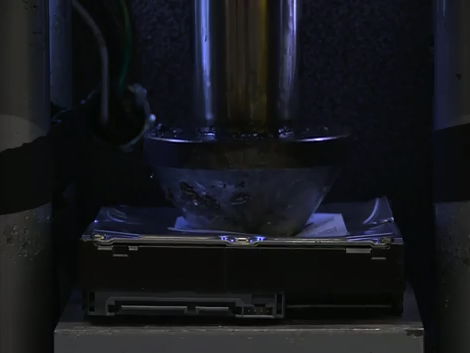
Nonetheless, when a hard drive fails or no longer exhibits prime performance and must be disposed of, Google uses multiple techniques to ensure that the data can't be read at all. It overwrites the data, and then it uses a complete disk read to verify that all data has been removed. When disk reaches the end of its life, Google will then destroy it. This involves pushing a steel piston through the center of the drive and then shredding it into relatively small pieces. The remains of the drives are then sent to recycling centers.

Google hard drive crusher

The Crusher: Google gives hard drives the piston treatment

What doesn’t get mentioned that I think is cooler than the low tech ways to handle hard drive security is Google’s shard methods to protect data and achieve scalability, but this is way too geeky for most users to be interested in.

We can hope that with the popularity of the video and news coverage that Google and others will create more data center videos.

Could you imagine a documentary style video of AWS outage?  Would the video be a comedy or drama?  A video of Sony’s playstation outage would be a tragedy, or comedy if you are from the Xbox Live team.

The Media Data Center War - Apple started with Music, Amazon started with Books, who will win?

Engadget reports reports on the Amazon Android powered Tablet for the Summer of 2011.

Amazon to take on Apple this summer with Samsung-built tablet?

By Thomas Ricker posted Apr 21st 2011 6:35AM

You really should pay attention when Engadget's founder, Peter Rojas speaks about the tech industry. Especially when he leads into a story like this:

It's something of an open secret that Amazon is working on an Android tablet and I am 99 percent certain they are having Samsung build one for them.

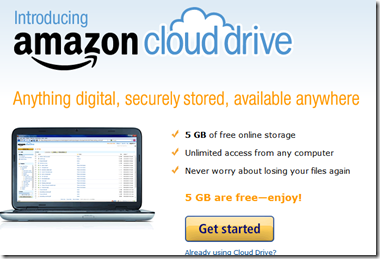
Which makes sense to follow the announcement of Amazon's cloud drive.

image

One data center guy I was talking to said the Apple guys aren't worried about Cloud Drive as Amazon will get sued.  I made the point that that makes sense if you are Apple, but not necessarily if you are Amazon.  Apple has had media companies like Apple Records battling the company for decades.  Amazon is looking to disrupt Apple's business models.  The huge margins Apple makes are opportunities for Bezo's crowd.

The battle for who will win the next media battle will be fought in the cloud in addition to the devices.  The data centers are key to the strategy. I place my bets on Amazon.  The media and loyal Mac users will be on Apple.  Amazon's thin retail margins has forced them to think efficiently, whereas Apple promotes think differently.

BTW, thinking efficiently usually aligns with less energy which is better for a green data center.

Greenpeace flies a blimp over Facebook HQ promoting a Greener Data Center

MercuryNews has an article with a picture of a Greenpeace sponsored blimp asking Facebook to join the energy revolution.

The environmental organization Greenpeace flies a blimp over Facebook's Palo Alto, Ca. headquarters on Thursday, April 14. Greenpeace has been urging Facebook to "UnFriend Coal" and to stop using coal and nuclear to power its data centers. ( courtesy of Greenpeace )

The Greenpeace Green IT team was at Green:NET 2011 presenting its report on data centers.  There was one company with their data center team in the Greenpeace presentation, but not Google, Apple, Yahoo, Microsoft, or any of the others in the Greenpeace report.

In a report released Thursday, Greenpeace, the environmental organization, takes companies like Apple (AAPL), Facebook and Twitter to task for powering their data centers with what it calls "dirty energy." Greenpeace wants tech companies to commit to clean, renewable energy sources, saying the world is running out of time as electricity demand skyrockets and the planet faces the potential for catastrophic climate change.

"We need to get off of coal as fast as we can," said Gary Cook, the report's author and head of Greenpeace's Cool IT Campaign. "Tech companies see themselves as being innovators, but when it comes to electricity they are buying it off the rack as cheaply as they can. If our campaign is successful, no one will want to be associated with coal."

Some may think the Greenpeace guys will go away, but my bets are this is the beginning.

Amazon's outages creates opportunity for Cloud Services that are transparent

Greenpeace tried to get information about Amazon Web Services cloud environment to determine an environmental impact.  Greenpeace scored Amazon an F.

image

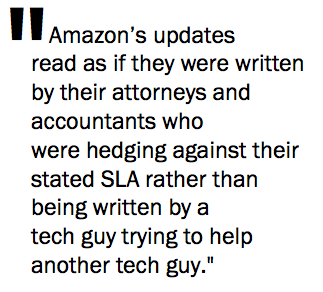
Geekwire has an written by a Seattle SW developer Keith Smith discussing the communication problem from Amazon and lack of transparency.

Today that lack of transparency has continued.

As problems continued throughout the day, we experienced the obvious frustration from the system failure. But Amazon’s communication failure was even more alarming.

7:30a on Apr 22.  Keith Smith's company Big Door is still down.

image

Isn't a bit ironic that the cloud is built on open source software, yet the services delivered look no different than proprietary closed systems when you dig for answers to tough questions like an environmental impact and what caused an outage?

Is cloud transparency a future feature differentiator?  Right now all the clouds are pretty obscure.