Explaining the lack of Data Center critics, Emperor's New Clothes paradigm

I am heading off to Uptime Institute and many times I wonder why there are not more open discussions on what goes on in the data center industry.  Whoever hold the most amount of influence many times is able to define the rules of the game that the players should follow if they expect to play and make money.  The influential are the customers, events, analyst, and vendors with the biggest budgets.

One analogy you could use to explain the lack of critics of the system is the Emperor's New Clothes story.

The emperor walked beneath the beautiful canopy in the procession, and all the people in the street and in their windows said, "Goodness, the emperor's new clothes are incomparable! What a beautiful train on his jacket. What a perfect fit!" No one wanted it to be noticed that he could see nothing, for then it would be said that he was unfit for his position or that he was stupid. None of the emperor's clothes had ever before received such praise.

"But he doesn't have anything on!" said a small child.

"Good Lord, let us hear the voice of an innocent child!" said the father, and whispered to another what the child had said.

"A small child said that he doesn't have anything on!"

Finally everyone was saying, "He doesn't have anything on!"

I don't blame anyone in the system for this behavior it just naturally occurs as no one is going to survive long as a data center critic.  The one exception is if a critic has a business model that thrives with change.
 

Sea Levels predicted to rise 2-3 ft by 2100

MSNBC has an article discussing the prediction that sea levels could rise by 2-3 ft by 2100.

STOCKHOLM — The Arctic is melting faster than expected and could contribute 2-3 feet more in global sea levels by 2100 than earlier thought, experts state in a report being presented to international officials on Wednesday. The report shatters predictions made four years ago by the authoritative U.N. climate change panel.

"The observed changes in sea ice on the Arctic Ocean, in the mass of the Greenland ice sheet and Arctic ice caps and glaciers over the past 10 years are dramatic and represent an obvious departure from the long-term patterns," the international Arctic Monitoring and Assessment Program says in its report.

Blue Collar vs. White Collar, understanding the separation between data center ops, IT, and business units

I posted on the idea of a System Program Manager in the data center.  In the same conversation I referenced, my friend and I were discussing how different data center ops is versus IT, let alone the business units who don't get their hands dirty. Getting your hands dirty is viewed by many as beneath them.

get your hands dirty  (informal)

to involve yourself in all parts of a job, including the parts that are unpleasant, or involve hard, practical work Unlike other bosses, he's not afraid to get his hands dirty and the men like that in him.

Then we discussed the idea of a blue collar worker.

What Does Blue Collar Mean?
A working-class person historically defined by hourly rates of pay and manual labor. A blue collar worker refers to the fact that most manual laborers at the turn of the century wore blue shirts, which could hold a little dirt around the collar without standing out.
This working class stands in contrast to white collar workers, which historically have had the higher-paying, salaried positions to go with their clean and pressed white shirts.

So, we asked the question is the hourly work force, the people who get their hands dirty touching the facilities like a Blue Collar worker?  Could the same be implied for IT hardware and IT software?

In addition much of the blue collar work will be outsourced to outside companies. Is the separation between data center ops, IT and business units the same type of behaviors that exist in other industries between the blue collar and white collar workers?

Will Automation automatically fix Amazon's Outage issues? automat* mentioned 9 times in post mortem

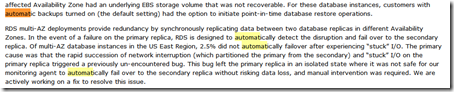
Amazon posted a while ago its post-mortem on the AWS outage.  One of the entertaining ways to look at the Summary is the number of times "automat*" gets used.

Here are a few examples.

image

For these database instances, customers with automatic backups turned on (the default setting) had the option to initiate point-in-time database restore operations.

RDS multi-AZ deployments provide redundancy by synchronously replicating data between two database replicas in different Availability Zones. In the event of a failure on the primary replica, RDS is designed to automatically detect the disruption and fail over to the secondary replica. Of multi-AZ database instances in the US East Region, 2.5% did not automatically failover after experiencing “stuck” I/O. The primary cause was that the rapid succession of network interruption (which partitioned the primary from the secondary) and “stuck” I/O on the primary replica triggered a previously un-encountered bug. This bug left the primary replica in an isolated state where it was not safe for our monitoring agent to automatically fail over to the secondary replica without risking data loss, and manual intervention was required. We are actively working on a fix to resolve this issue.

So, AWS figured out there was a bug in the monitoring agent to automatically fail over.

This bug left the primary replica in an isolated state where it was not safe for our monitoring agent to automatically fail over to the secondary replica without risking data loss, and manual intervention was required. We are actively working on a fix to resolve this issue.

And, they are going to fix the problem with more automation.

image

We will audit our change process and increase the automation to prevent this mistake from happening in the future.

Here are a few more areas where automat* is mentioned.

image

We’ll also continue to deliver additional services like S3, SimpleDB and multi-AZ RDS that perform multi-AZ level balancing automatically so customers can benefit from multiple Availability Zones without doing any of the heavy-lifting in their applications.

Speeding Up Recovery

We will also invest in increasing our visibility, control, and automation to recover volumes in an EBS cluster. We have a number of operational tools for managing an EBS cluster, but the fine-grained control and throttling the team used to recover the cluster will be built directly into the EBS nodes. We will also automate the recovery models that we used for the various types of volume recovery that we had to do. This would have saved us significant time in the recovery process.

With automat* mentioned so many times, it makes you think there is a lot of manual work going on in AWS.

If you want an automated private cloud, you could learn from some of the original AWS EC2 team as they started the company http://nimbula.com/

image

Diversity is better for innovation, commonality is better for managers

The Green Data Center has become a common term, and quite frankly I am getting bored.  Same stuff, LEED certification, solar panels, lower PUE, etc.  Are these really innovation or the accepted terms for what green data centers exhibit?

What is really innovative in green data center design?

I think the new stuff is going to be integration of complete systems not data center features that gets marketed.  But, getting a bunch of smart people all together doesn't necessarily support innovation.  Why?  Read this article for an example of the problem.

Great Minds Thinking Alike Doesn’t Foster Innovation

February 4, 2011 in Article, Innovation, Links | by John Philpin | Leave a comment

This article delivered through the ‘Interwebs’ this very morning. Our thanks to our friends at Perfect Labour Storm. A great read – do you agree. What do you think ?

“Great minds think alike” – I don’t know how many times I’ve heard that in my life. In fact, I probably spoke those very words dozens of times.  But new research is questioning how effective sameness is as a competitive strategy.  One recent study suggests that similar minds might make management easier, but it doesn’t breed innovation.

Some of the most boring meetings I've had is when the whole team from one company thinks the same and the conversations are within the boundaries.  If everyone looks the same, there is a high probability they think the same.

An article published in Inc. magazine highlights a recent study, which set out to discover how employee diversity within workgroups affects the group’s overall performance.  According to Bill Swann, a professor of psychology at University of Texas at Austin where the study was completed, groups with members who “externalized their personal identities” (i.e. students who expressed individuality) were more successful than groups with members who tended to downplay their personalities.  A few experts offered advice how diversity within a company can be used as a strategic advantage to “create better innovation, better products, and ultimately, a better company.”

How diverse is your data center team?