On the road with my new Verizon 4G wifi modem, on the bus 8 Mb down, 5Mb up

On April 18, Verizon finally shipped the Verzion 4G Novatel 4510L modem, and I upgraded right away from my 3G modem.  I am on a bus now riding to Seattle, then taking the light rail to the airport.  How fast is my 4G modem on a bus on the freeway?  Speedtest results.

image

Many of my travelling friends use the Verizon mifi 3G modem, so I expect them to upgrade soon. 

I don't know about you, but I am totally frustrated with free internet in hotels and conferences.  The bandwidth sucks too many times.  I've gotten as high as 12Mb down and 8 Mb up on my 4G modem.  For the monthly subscription fee, this is a no brainer.

Here is the Verizon web page.  I held out for the Novatel modem, passing on the Samsung.

image

One solution addressing data center information silos, system program manager

Much of my career at Microsoft I had the role of program manager, and today I had lunch with another ex-Microsoft program manager and discussed data center/IT operations and what is needed to address the silos and fiefdoms that exist in IT.  After a bunch of discussions, I asked why isn't there program manager for data center systems?

GPS navigation has a system program manager which interesting enough sounds like it could describe an data center/IT system.

GPS World: What do you see as the
current priorities for the GPS Joint
Program Office?
Col. Ballenger: Our No. 1 priority
is mission success. How we accomplish
that is to make sure that our users, both
military and civil, receive their position,
navigation, and timing information —
with high availability and high assurance
— wherever they are around the globe. I
translate that into two key jobs that we do
here in the Joint Program Office.
Number 1: Sustain the capabilities
that we have on orbit today — and that
includes designing, launching, and replenishing satellites, and making sure that the
ground control system and network of
ground antennas stay properly maintained
and sustained and upgraded over time.
Job Number 2 is modernizing the GPS
capability to move us into the future. So,
really, mission success has two constituent parts: Sustain the constellation and
modernize the constellation, the constellation being a euphemism for the larger
system.

Program managers have different types of roles at different companies and over time the roles can change.  I remember once being in a meeting with Paul Maritz when he was a Microsoft VP, and he explained how program manager have different roles at Microsoft than other companies.  Here is what program managers used to be at Microsoft.

When I was hired 1994 there was a cult around the role. Program Managers had a reputation for being people worthy of being afraid of for one reason: they knew how to get things done. If you got in their way, they would smile. And then eat you. They drove, led, ran, persuaded, hunted, fought and stuck their necks out for their teams with an intensity most people couldn’t match. The sort of people who eliminated all bullshit within a 10 foot radius of their presence. How to be this way, and do it without being an asshole, was one of the things I tried to capture in my book, Making things happen. All teams need at least one leader who has this kind of passion and talent regardless of where you work or what you’re working on.

As this post continues it is difficult though to set up program managers for success when bureaucracy grows.

One change is the enormous growth of Microsoft since I was hired. I started in ’94 as employee #14,000 something, and now there are nearly 90,000. Bureaucracy, overhead and dead weight collect in big successful companies and Microsoft is no different. This makes it much harder to consolidate the kind of power a PM needs to behave the way I described above. The PM role has been stretched so thin there are PMs for everything, and if ever a position needs to be created that isn’t quite a marketing, programmer or tester position, but isn’t a leadership or management role, the PM label gets used anyway. Somehow it’s a crime for there to be more than 10 job titles at a company. I’m not sure why.

Changing data centers system is required to green the data center.  This requires a concentration of power into smaller group of individuals which is probably why data centers and IT don't have program managers the way that Microsoft used to. 

If the US military has figured out they need system program manager for complex systems like GPS, shouldn't the idea work for data centers?


What is the future of the data center? Looking for patterns of SW and HW

I’ve been heads down this past week working on some research on the future of data centers.  Here are a few thoughts after a week of pondering.

Part of the problem in data centers is the lack of awareness by the various parties in developing data centers.  I stopped being surprised when facility operations team had no idea what hardware and software is running in data centers.  Part of the problem is people don’t take the time to communicate how things are changing.

Imagine you are a Disney attraction park.

image

And the facility operations team mindset was “as long as the park was running, their job is done.”  Silo'd thinking is pervasive in data centers in IT as the overall system is so complex, and quite frankly the other parts are many times boring.  Do facility ops team get excited about the new cloud environment or a ruby on rails deployment?

Rails Web development that doesn't hurt

I think the responsibility for fixing this problem resides in management as it is difficult if not impossible for individual contributors to change the mindset.  FYI, when I reviewed this post, it reminded me that Mike Manos worked for Disney Interactive, and maybe he picked up some ideas on how the team needs to work together for the common goal.

Verizon publishes Carbon per Terrabyte metric, 15% improvement 2009 - 2010

Verizon has a press release on its new carbon metric.

Verizon Develops New Metric to Accurately Measure Company's Carbon Efficiency as Broadband, IP, Wireless and Video Services Grow

Metric Will Help Company to Continue Its Energy-Conservation Improvements Amid Increasing Demands on Its Network

NEW YORK – April 28, 2011 –

Verizon has developed a new metric for measuring carbon efficiency, enabling the company, for the first time, to accurately quantify the impact of all of its green initiatives.

The metric will help Verizon continue to make improvements in energy conservation and efficiency, as the rapid increase in demand for broadband, IP network services, wireless data and video increases the demands on the company's network - and the amount of energy needed to operate the network.

Called the "carbon intensity metric," the new measurement was developed by Verizon's Sustainability Office and tested over the past 12 months. The tests showed an improvement of approximately 15 percent in the company's carbon efficiency, from 2009 to 2010.

The metric is derived by first combining Verizon's total carbon emissions (in metric tons) from the electricity, building fuels and vehicle fuels used to run the company's business. Then, that total is divided by the number of terabytes of data that the company transports across its network. (One terabyte equals about 300 feature-length movies.) Verizon transported 78.6 million terabytes across its global network in 2010 - an increase of about 16 percent, compared with 2009.

We’ll see if others adopt this method.

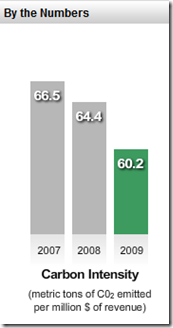
One area where I found deceptive is this graph on the Verizon environmental site.

image

Note how the scale is not provided from 2007 – 2009 there is 10% reduction, but the graph deception makes the reduction look like over 33%.  It’s too bad you can’t make money by finding deceptive graphing techniques, it would keep the marketing folks a lot more honest.

Hot Ticket where EU gets priority, Google’s Data Center Summit 2011 in Zurich May 24

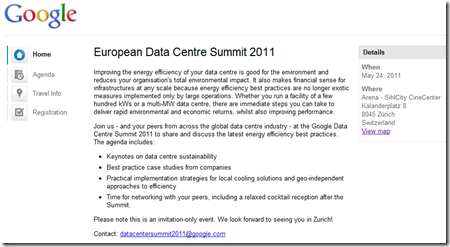
Google will officially announce its Data Center Summit 2011 next week for the world of Google data center followers.  Attendance is limited so not everyone can go.  What will get you to the top of the list of potential attendees is if you are based out of the EU and you have a passion for energy efficiency in the data center. 

Information about the Summit itself is straightforward - innovative thinkers and industry leaders are coming together to discuss energy efficiency best practices for data centres. For Google's part, we will share the total cost of ownership analysis of a computing and network room (CRN) retrofit and explain how seawater cooling makes sense for our facility in Finland. Other presenters will give similar accounts of the results from adhering to efficiency best practices as well as taking advantage of local cooling solutions. We are hoping to see the European data centre community continue to focus on improving operational efficiency.

If you don’t qualify pass this post on to a Green Data Center friend in the EU.

image

With Google’s permission I am sharing the event web site before they post the event on their blog next week.

image

Here is the event schedule with speakers.

Event Schedule

8:30
Keynotes on data centre sustainability and best practices
Zahl Limbuwala, Chartered Institute for IT; Harkeeret Singh, The Green Grid

10:00
Best practice implementation case studies
Joe Kava, Google; Dean Nelson, eBay

11:20
Panel discussion
James Hamilton, Amazon; Robert Coupland, Telecity Group; Brian Waddell, Norman Disney and Young; Mark Eichenberger, UBS

12:00
Lunch

13:30
Local cooling solutions and geo-independent approaches to efficiency
Joe Kava, Google; Dileep Bhandarkar, Microsoft; Jochen Berger, PlusServer; Chris Malone, Google

15:50
Panel discussion
Mark Monroe, The Green Grid; Andre Oppermann, DeepGreen; Bruno Michel, IBM Research Lab; Jeff Monroe, Verne Global

17:00
Reception

I’ll be at the event and most likely will attend DataCenterDynamics Zurich the day after and try to add some data center tours while I am there.

image