Tricks of the Trade,"Turning Numbers into Knowledge", info for the new wave of Data Analysts

I just received from amazon.com Jonathan Koomey's Turning Numbers into Knowledge book, and one of the things that caught my eye is the Foreword where

There is nothing else like this book out there.
Nobody who deals with problems where numbers matter—and everybody in today’s world really needs to—should be without it.
John P. Holdren*
Woods Hole, MA, October 2007

And Professor Holdren explains the "Tricks of the Trade" course he taught at UC Berkeley.

Berkeley’s guardians of academic respectability eventually made me change what they regarded as too frivolous a title for the course to “Professional Methods for Interdisciplinary Careers”, but the focus remained the same for the 15+ years that I taught it. It covered ways of thinking through complex problems; how to find and manage information; how to function in a committee; how to identify and avoid common pitfalls in the interpretation of data; how to present results clearly in words, graphs, and tables; how to manage one’s time; and even how to avoid jet lag.

Many students over the years suggested that I should write a book teaching the “Tricks of the Trade”. Notwithstanding my advice to others about time management, however, I never found the time to write it.

With the 2001 publication of the first edition of Jonathan Koomey’s remarkable book, Turning Numbers into Knowledge, I realized that I no longer needed to try. Dr. Koomey, who had taken my course in the 1980s as a Berkeley graduate student, had plenty of ideas of his own about the need and how to fill it. And the book that he wrote surpassed what I would have done, if I had found the time, in every important respect

WSJ has a post on how there is a new wave of Business Schools planning to educate students in data analysis.

Business Schools Plan Leap Into Data

By MELISSA KORN And SHARA TIBKEN

Faced with an increasing stream of data from the Web and other electronic sources, many companies are seeking managers who can make sense of the numbers through the growing practice of data analytics, also known as business intelligence. Finding qualified candidates has proven difficult, but business schools hope to fill the talent gap.

This fall several schools, including Fordham University's Graduate School of Business and Indiana University's Kelley School of Business, are unveiling analytics electives, certificates and degree programs; other courses and programs were launched in the previous school year.

Some of the students who are thinking of getting into Data Analytics should consider Jonathan Koomey's book, Turning Numbers into Knowledge.


Turning Numbers into Knowledge: Mastering the Art of Problem Solving

Jonathan Koomey's v2.0 of Data Center Energy use shows slower growth than expected


The NYTimes has an article about Jonathan Koomey's research.

Data Centers’ Power Use Less Than Was Expected

By JOHN MARKOFF
Published: July 31, 2011

SAN FRANCISCO — Data centers’ unquenchable thirst for electricity has been slaked by the global recession and by a combination of new power-saving technologies, according to an independent report on data center power use from 2005 to 2010.

Here is Jonathan's blog post.

My new study of data center electricity use in 2010

I just released my new study on data center electricity use in 2010.  I did the research as an exclusive for the New York Times, and John Markoff at the Times wrote an article on it that will appear in the print paper August 1, 2011.  You can download the new report here.

Stock1

I research, consult, and lecture about climate solutions, critical thinking skills, and the environmental effects of information technology.

What are the three reasons Jonathan references as the reason for slower energy use vs. the 2007 study he researched?

  1. 2008-9 economic crisis
  2. the increased prevalence of virtualization in data centers
  3. the industry’s efforts to improve efficiency of these facilities since 2005

My assumption is Jonathan as a numbers guy would put these in order of significance. So, if the economy did not hit the rough spot in 2008 - 9, then the energy growth would  be much bigger.  The economy was a bigger factor than virtualization, aka the cloud.  And virtualization cut more energy than PUE improvements.  Although as the NYTimes says it is difficult to break down the numbers, sometimes you need to trust your gut on what feels right and I agree with these assumptions.

Though Mr. Koomey was unable to separate the impact of the recession from that of energy-saving technologies, the decline in use is surprising because data centers, buildings that house racks and racks of computers, have become so central to modern life. They are used to process e-mail, conduct Web searches and handle online shopping as well as banking transactions and corporate sales reports.

But, let's look at who did double, triple, quadruple their data centers from 2005 - 2010.

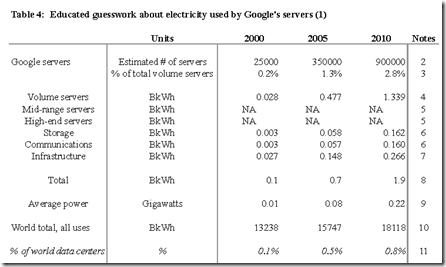
Google almost tripled the number of servers from 2005 - 2010 going from 350k to 900k of servers with an energy use of 0.7 BkWh to 1.9 BkWh.

image

Facebook launched in Feb 2004 and now has 100,000+ Servers.  In 2005 Facebook may have 100 servers, so 1,000 fold increase.

Zynga started in Jan 2007 probably has 50,000+ servers if you count the ones in AWS.  Infinite vs 2005

Amazon Web Services launched July 2006 has probably close to 100,000 servers.  Infinite vs. 2005.

Jonathan worked on the EPA study for 2007, and he released v2.0 update Aug 2011.  I think someone needs to fund his research so he published at least every other year. Infinite vs. 2005.

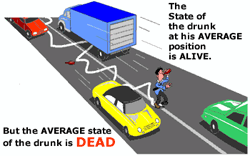
So, even though the average only moved 56%.  What is much more interesting to me is the guys who were far above the average.  Too many times people focus on the average as they can't think about the range of the numbers.  Dr. Sam Savage has called this the Flaw of Averages.

The error of a single number view vs. the range can be illustrated by the "Flaw of Averages."

The Flaw of Averages
A common cause of bad planning is an error Dr. Savage calls the Flaw of Averages which may be stated as follows: plans based on average assumptions are wrong on average.

As a sobering example, consider the state of a drunk, wandering around on a busy highway. His average position is the centerline, so...

Google posts Sustainable (Green) Data Center Operations Manager position

I don't know how long this job post has been up, but it is worth blogging.

Manager, Sustainable Data Center Operations - Mountain View

...

As the Sustainable Data Center Operations Manager you will be responsible for growing the team that continually raises the bar on sustainability at Google. This includes keeping our commitment to carbon neutrality, advancing efficient computing across the industry, and ensuring Google’s infrastructure, products and services are sustainable. You will provide leadership for Google’s sustainability efforts, defining goals, organizing teams, and working closely with product engineering, operations, policy, and communications teams.

Good Luck to Google to hire a Green Data Center Operations Manager.