Jonathan Koomey's v2.0 of Data Center Energy use shows slower growth than expected


The NYTimes has an article about Jonathan Koomey's research.

Data Centers’ Power Use Less Than Was Expected

By JOHN MARKOFF
Published: July 31, 2011

SAN FRANCISCO — Data centers’ unquenchable thirst for electricity has been slaked by the global recession and by a combination of new power-saving technologies, according to an independent report on data center power use from 2005 to 2010.

Here is Jonathan's blog post.

My new study of data center electricity use in 2010

I just released my new study on data center electricity use in 2010.  I did the research as an exclusive for the New York Times, and John Markoff at the Times wrote an article on it that will appear in the print paper August 1, 2011.  You can download the new report here.

Stock1

I research, consult, and lecture about climate solutions, critical thinking skills, and the environmental effects of information technology.

What are the three reasons Jonathan references as the reason for slower energy use vs. the 2007 study he researched?

  1. 2008-9 economic crisis
  2. the increased prevalence of virtualization in data centers
  3. the industry’s efforts to improve efficiency of these facilities since 2005

My assumption is Jonathan as a numbers guy would put these in order of significance. So, if the economy did not hit the rough spot in 2008 - 9, then the energy growth would  be much bigger.  The economy was a bigger factor than virtualization, aka the cloud.  And virtualization cut more energy than PUE improvements.  Although as the NYTimes says it is difficult to break down the numbers, sometimes you need to trust your gut on what feels right and I agree with these assumptions.

Though Mr. Koomey was unable to separate the impact of the recession from that of energy-saving technologies, the decline in use is surprising because data centers, buildings that house racks and racks of computers, have become so central to modern life. They are used to process e-mail, conduct Web searches and handle online shopping as well as banking transactions and corporate sales reports.

But, let's look at who did double, triple, quadruple their data centers from 2005 - 2010.

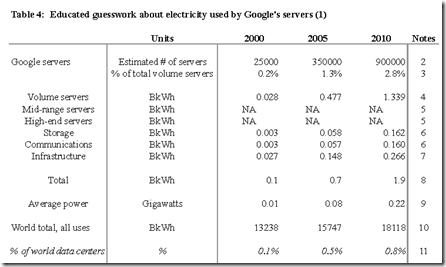
Google almost tripled the number of servers from 2005 - 2010 going from 350k to 900k of servers with an energy use of 0.7 BkWh to 1.9 BkWh.
image

Facebook launched in Feb 2004 and now has 100,000+ Servers.  In 2005 Facebook may have 100 servers, so 1,000 fold increase.

Zynga started in Jan 2007 probably has 50,000+ servers if you count the ones in AWS.  Infinite vs 2005

Amazon Web Services launched July 2006 has probably close to 100,000 servers.  Infinite vs. 2005.

Jonathan worked on the EPA study for 2007, and he released v2.0 update Aug 2011.  I think someone needs to fund his research so he published at least every other year. Infinite vs. 2005.

So, even though the average only moved 56%.  What is much more interesting to me is the guys who were far above the average.  Too many times people focus on the average as they can't think about the range of the numbers.  Dr. Sam Savage has called this the Flaw of Averages.

The error of a single number view vs. the range can be illustrated by the "Flaw of Averages."

The Flaw of Averages
A common cause of bad planning is an error Dr. Savage calls the Flaw of Averages which may be stated as follows: plans based on average assumptions are wrong on average.

As a sobering example, consider the state of a drunk, wandering around on a busy highway. His average position is the centerline, so...

Google posts Sustainable (Green) Data Center Operations Manager position

I don't know how long this job post has been up, but it is worth blogging.

Manager, Sustainable Data Center Operations - Mountain View

...

As the Sustainable Data Center Operations Manager you will be responsible for growing the team that continually raises the bar on sustainability at Google. This includes keeping our commitment to carbon neutrality, advancing efficient computing across the industry, and ensuring Google’s infrastructure, products and services are sustainable. You will provide leadership for Google’s sustainability efforts, defining goals, organizing teams, and working closely with product engineering, operations, policy, and communications teams.

Good Luck to Google to hire a Green Data Center Operations Manager.

Three Rules for Writing Blog Posts - build relationships, tell me why, be different

One of my friends is starting a technical blog and he sent me a draft of his first post.   I made a few comments and I found this post that had same good ideas buried down towards the end of the post.  I could try to paraphrase this, but the author made some good points to consider and he didn't a good job explaining three good rules to post on.

I'll insert some comments in his text.

Impact on your writing: three critical concepts you must adhere to

This is why most press releases fail to be viral, and quite dull, and in general the more corporate PR gets involved in the messages the less people read it.

1.  Build relationships with your audience

Social networks like a personal approach.  They want to see your personality.  They want you to share. They want you to evoke emotions.  These elements are key to creating engagement not just with your content, but with you.  Social networks make you more accessible to your potential readers and can play a significant role in growing your reach.

Think of this point as what do people want vs. what do you want?  You may want to be viewed as an authority and trusted advisor, but do people trust someone they do not know?  People want to feel like they can trust the information.  People trust people.  People get suspicious of information they cannot look up where the information came from.  Ahh, the information came from this person.

I remember when I first began publishing sites on the Web, the approach I used was dry and academic.  This was the strategy I used to communicate authority and trust.  I am beginning to think that this is no longer the right approach.  Do you trust the advice of a university professor that you have never spoken to?  Or does the combined opinions of your friends count for more?

This is why being a blogger is part of the social web.

The wisdom of the crowd is very much upon us and it is only going to get stronger.  As a writer, you need to accept the notion that trust comes from familiarity with you, and your ability to be approachable will enable you to communicate your message.

I totally agree with this point and from the day I started blogging,  I was frustrated with blogs that pointed to things, but didn't say why I should care about this post and what was in it.

2.  Tell me why I care

The other big factor that emerges from the ability to get all the world’s information online is that there is too much information. We are more impatient than ever.  If I am going to spend the time reading your article, whether or not I trust you, tell me why I should read this article in the first paragraph.  Get to the point.

Do you want to a thought leader or a follower?  Who reads the followers?  Think of stuff no one else does.  Or at least try.

3.  Strive for uniqueness, not “me too”

Lastly, don’t waste your time writing “me too” content.

Amazon's HW Engineering Product Manager position focuses on delivering new server designs

Amazon has a different approach than I've seen others take.  Opening a product manager position in HW Engineering.

The Product Manager is responsible for the discovery and aggregation of new and emerging technologies in our industries. They collaborate with our engineering staff to define and deliver new server designs for use by all Amazon.com and AWS services. They manage the technical relationships with the key players in our vendor ecosystem, and own the development and execution of our business metrics.

The job is in this group.

The Amazon Hardware & Operating System Engineering team, within the Infrastructure group, provides the server platform for our innovative web service and e-commerce technology platforms. This platform is industry-leading in terms of frugality and operational excellence, and is critical to the success of the AWS business and the thousands of customers who use utility computing today.