Don't make the mistake Lotus did, betting against the adoption of new technology, Win3.1

A long time ago, almost 20 years ago, Microsoft was launching Win3.1 while the dominant installed base was MS-DOS.   Win3.0 had done OK, but much of the installed base of apps were DOS apps.  Microsoft was trying to get developers to write Windows apps.  One of those companies who dragged their heals to create Windows app was Lotus 123.  So, when Windows 3.1 shipped you could run Lotus 123 in DOS mode or you could run another spreadsheet not as popular, but had been ported from the Mac to Windows, called Microsoft Excel.  Microsoft Excel became the spreadsheet app to use on Win3.1.  And, Lotus 123 never recovered its #1 spreadsheet market on the PC.

Amazon has launched Kindle Fire and there are companies like Netflix that will drag their heals to port their applications to the Amazon Kindle Fire.  Just because an app is dominant on Android marketplace or Apple app store doesn't mean the Kindle Fire users will wait for the port to eventually show up.

Just like when the PC was having the battle between CP/M, DOS, and Windows operating system frustrating developers.  The battle is between Google, Apple, and Amazon.

We'll see who wins and loses if Amazon Kindle Fire is a winner.
Smarter Cities build your own data center or be in the cloud

Smarter Cities is a hot topic with IBM, CIsco, Schneider Electric and many other data center vendors targeting the growth.

A common approach is to leverage the cloud as Barron's writes.

Dawn of the Smart City

The next generation will see a historic migration to urban areas around the world. So who's going to benefit?

Cities are experiencing one of the biggest booms since the Industrial Revolution got under way.

In 2008, the number of urban dwellers for the first time in history eclipsed the number living far from the madding crowd. The United Nations projects that by mid-century, cities will be home to 70% of the world's 9.2 billion inhabitants, a figure that tops today's population by 30%.


The Cloud is mentioned.

Like Siemens and ABB, most of the beneficiaries of urbanization will be infrastructure and technology outfits that provide or utilize smartphones, sensors and software and services to track the use of a city's assets and commit resources when and where they're needed. Cloud technology, which can cut costs while boosting computing capacity, will play a big role. Even social media will participate, as cities multiply the ways a citizen can spot a problem–anything from a water-main break to a traffic snarl–and then alert others to avoid it or do something about it.

Technology researchers at IDC estimate the size of the smart-city information-technology market is now $34 billion annually and will gain 18%-plus a year to $57 billion by 2014. That's not a huge amount to global giants, but certainly enough to help drive growth. (The companies don't break out earnings related to these projects.) The market has broadened to include items like broadband connectivity, green belts, renewable energy, green buildings and other intelligent-city systems. "You are talking about smart water, smart transportation, better public safety," says Jennifer Bélissent, a consultant at Forrester.

And, more details including a Microsoft Windows Azure case study are referenced.

Says Bob Djurdjevic of Annex Research, who follows big-cap tech stocks: "The cloud and smarter cities work hand-in-glove. The 'what' is the idea of the smarter city. The 'how' is the cloud, which provides the means for bringing it about."

Typically, a city funds big capital investments by issuing 15-20-year bonds, which require voter approval. But for many of these improvements the city doesn't need a public referendum or a bond sale; it can pay subscription fees for computer usage to a cloud provider like IBM or Microsoft. That saves major capital expenses for physical infrastructure upgrades and repairs, and keeps the investment as an operational expense. Cities can start small and scale up as usage rises.

Miami built a 311 service, which lets city dwellers call in for information or report a problem, on Microsoft's Windows Azure cloud platform. The service, which tracks progress on the issue from the time it was reported until it's been solved, produced a 75% savings on projected first-year costs because Miami didn't need to buy, host and manage physical servers. When Hurricane Irene churned up the coast in August, the city was able to add a special site on its platform to handle reports about the deadly storm. Says Eric Basha of Microsoft: "The cloud is transforming how government delivers services, driving down costs and time to market." That also provides opportunities for any vendor with cloud-related products, including Accenture (ACN), Hewlett-Packard (HPQ) andOracle (ORCL).

But, another view that will not get as much press is building data centers in cities to support the new services and a low latency work environment is just as valuable as the cloud.  Look at the large US cities and their data centers - NYC, Atlanta, Chicago, Dallas, LA, SF/SJ, Seattle, Denver, and Phoenix.  They all have large data centers.  Cities not thinking about the data center infrastructure they need to build out are going to be sorry they put their solution in the cloud without a clear migration strategy into local data center assets.


Google announces Dublin Green Data Center Project, uses proven perfected air-cooling technology

The media has been covering Google's New Dublin Green Data Center project.  A Google News search is here.  But I wanted to know the facts Google released, so below is the full press release.

Particular parts that I like and has the potential to set a new benchmark for PUE.  How low can Google's PUE go?

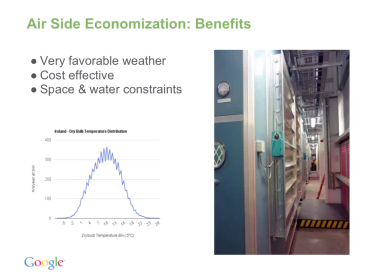
Once complete, the facility will rank amongst the most energy-efficient data centres in the world. Google will use advanced air-cooling technology that has been tested and perfected at Google’s existing rented datacenter facility in Dublin. This technology takes advantage of Ireland’s naturally cool climate and uses outside air to cool computers instead of costly and energy-hungry air-conditioning units.

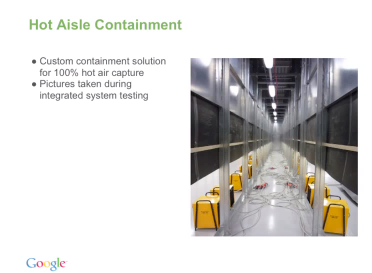
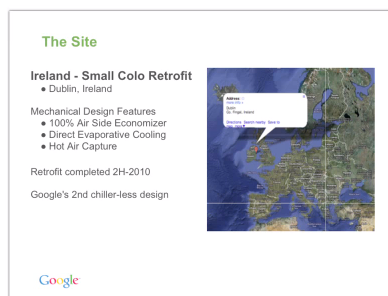
Here are a few pictures from the Google Data Centre Summit 2011 where the existing Dublin Data Center is mentioned.

NewImage

Here is information about Google's existing Dublin deployment.

NewImage

NewImage

NewImage

NewImage

Most likely you have not seen this video as it only has 265 views.

The following is the complete local press announcement Google made on its new Dublin Data Center project.

Minister Bruton announces new €75m investment by Google in energy-efficient, air-cooled data centre in Dublin

New project to provide more than 200 jobs for local and national construction firms, and up to 30 full-time and contractor jobs once operational.

Dublin – Mr Richard Bruton, TD, Minister for Jobs, Enterprise and Innovation, today announced that Google has acquired 11 acres of land and an existing building on Dublin’s Profile Park and will soon begin construction work on a highly energy-efficient data centre.  A data centre is a specialised building full of computers that run online services such as the Google search engine, Gmail and Google Maps.

Once complete, the facility will rank amongst the most energy-efficient data centres in the world. Google will use advanced air-cooling technology that has been tested and perfected at Google’s existing rented datacenter facility in Dublin. This technology takes advantage of Ireland’s naturally cool climate and uses outside air to cool computers instead of costly and energy-hungry air-conditioning units.


Google will invest up to 75 million Euros in the acquisition, build and fit out of its new facility, and will provide work for over 200 people from local and national firms at the peak of the construction phase. The contractors have already been selected after taking part in a competitive bid process.


Once operational, the centre will employ up to 30 people in a variety of full-time and contractor roles, including computer technicians, electrical and mechanical engineers, and catering and security staff. The new data centre will be in addition to Google’s existing rented datacenter facility in Dublin, which will continue to operate. Google already employs over 2,000 people in Dublin, and last year also bought three major office buildings in central Dublin, including Dublin’s tallest commercial office building, Montevetro.


Minister Bruton said: “As I have said repeatedly, the global cloud computing industry offers Ireland a massive opportunity for jobs and economic growth. I am determined that government will act decisively to seize that opportunity, and that is why I have established a cross-government implementation group to ensure that prompt action occurs.”

He continued: “The decision by Google, one of the most important multinational companies in Ireland, to locate a state-of-the-art data centre in Dublin is an endorsement of our policies in this area, and a sign of what is possible if we continue our focus”.

“We’re very happy to continue investing in Ireland and to build out our presence here even further,” said John Herlihy, head of Google Ireland. “The new data centre will be one of the most energy-efficient in Google’s global fleet. This investment further strengthens our presence here, and I’d like to thank IDA Ireland for the assistance they gave us in selecting this site.”

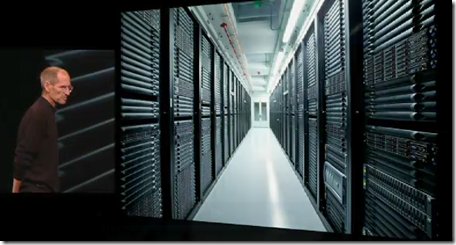
Jeff Bezos shows a Data Center Image just like Steve Jobs did

Publishing data center pictures be on the web Is something that is forbidden.  Unless you are the CEO.

Jeff Bezos shows a picture of Amazon's Web Services data centers to support Amazon Silk.

NewImage

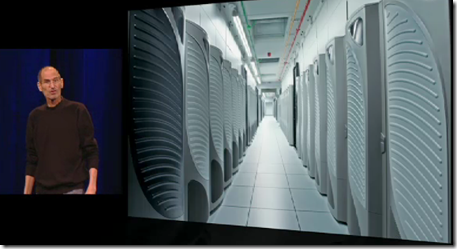
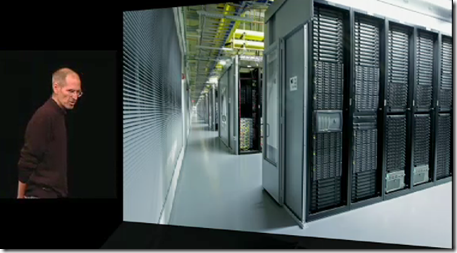
Is Jeff Bezos coping Steve Jobs when he discussed iCloud?  Check out my post on what Steve Jobs showed in his keynote.

"Full of stuff.  expensive stuff."  More laughs.  Who would ever call millions of dollars of IT equipment stuff?  You won't see Jobs calling an iPhone, iPod, or iPad stuff.  Do you think he is making fun of the other stuff he doesn't make?

image

image

image

OMG, can you imagine if Amazon let you rent DVDs?

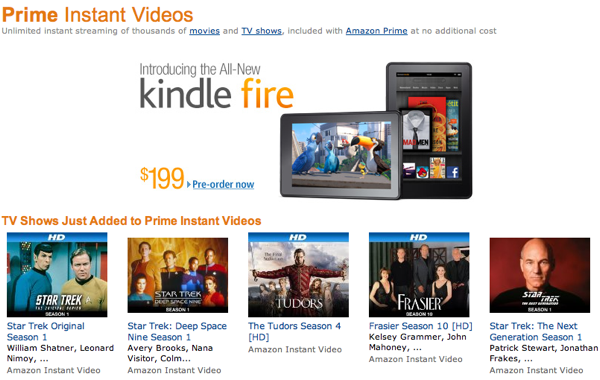
There is huge amount of news on Amazon's Kindle release.  i have ordered mine.  It is hard to argue with $199 especially if you already are an Amazon Prime user.  Amazon is figuring out that Prime is its money making user base.  As ZDNet points out the Amazon Prime users are where the money is for Amazon.

2x to 5x: Spending levels of Amazon Prime subscribers over non-Prime subscribers.

Here is the Kindle Fire Commercial.

But, here is a good question to think about.  Given Netflix self-inflicted wounds of separating DVD Rental from streaming, what happens if Amazon Prime starts a DVD Rental business?  You can rent movies from Amazon through streaming.  Why couldn't Amazon have yellow envelopes to compete against Netflix's Red envelopes.  Sorry Qwikster's red envelopes.

NewImage

Amazon has distribution warehouses around the world.  Now you could say why waste the time to rent DVDs.  Streaming is the future.  If this was true why doesn't Amazon get out of the business of selling DVDs?  This is all about economics and business models.  Reinventing Retail!!!

Can Amazon Prime be in the same business as Qwiksterh (Netflix) DVD rental?  Yes.  Will they.  If the numbers make sense.  Why not?

NewImage