NYTimes Publishes Two Letters to Editor, DC Most Inefficient users of Energy

I hope this gives you a laugh.  I did.  The NYTimes chose two letters to publish about the infamous James Glanz article on Sept 27. 

Here is the first to make you laugh.

To the Editor:

For the last decade at least, we have been told that computerizing everything imaginable was part of an overall strategy of “going green.” Now we discover that computers are among the world’s most profligate, inefficient users of energy and that “the cloud” is a carbon-intensive, diesel particulate-spewing, eco-unfriendly fog.

The party ended last night, and the beer goggles just came off. I feel really dirty this morning.

CINDY BROOMAN
Delaware, Ohio, Sept. 25, 2012

So who is Cindy Brooman?  A 61 year old small business owner of web site Point and Click Software.  Wow Cindy thinks data centers are the most inefficient immoral users of energy.  Her server hoster is a 200% renewable energy user which makes you think Cindy is a hardcore environmentalist.

OSServerLast changedIP addressNetblock Owner
F5 BIG-IP Microsoft-IIS/6.0 2-Oct-2012 66.96.143.162  Endurance International Group, Inc.

And the other letter is from NRDC promoting their upcoming cloud report.

A coming Natural Resources Defense Council report will reveal that not all clouds are created equal; there are “green” clouds and “brown” clouds. Those that carry out energy-efficiency best practices and use low-carbon energy sources are far more sustainable than typical server rooms.

Now these are the two letters that the editor choose to put into print.  Talk about a waste.

I can’t wait to see what James Glanz fires out next.  This is quite entertaining.


Time for Data Center Marketing to change? Gangnam Style

I don't think you you can say that Data Center Marketing is innovative.  Not to say the people aren't smart, but by nature the data center industry is risk adverse and uses methods that have been proven over time.  I am sure you have all noticed how you are ignore the marketing messages more and more.  Trade shows are more about networking than seeing the latest technologies.  Ads may get lots of eyeballs, but they don't meet expectations to marketing departments with few leads.

Some of the most innovative events have been when people host social events.  Steve Manos has his "On Tap" events in Chicago.  A group of us have a "downtime" event, (the opposite of uptime).

Wake up the Old Way of Marketing is Dead.  HBR blog network has a post.

Marketing Is Dead

Traditional marketing — including advertising, public relations, branding and corporate communications — is dead. Many people in traditional marketing roles and organizations may not realize they're operating within a dead paradigm. But they are. The evidence is clear.

...

Restore community marketing. Used properly, social media is accelerating a trend in which buyers can increasingly approximate the experience of buying in their local, physical communities. For instance, when you contemplate a major purchase, such as a new roof, a flat screen TV, or a good surgeon, you're not likely to go looking for a salesperson to talk to, or to read through a bunch of corporate website content. Instead, you'll probably ask neighbors or friends — your peer network — what or whom they're using.

...

Find your customer influencers. Many firms spend lots of resources pursuing outside influencers who've gained following on the Web and through social media. A better approach is to find and cultivate customer influencers and give them something great to talk about. This requires a new concept of customer value that goes way beyond customer lifetime value (CLV), which is based only on purchases. There are many other measures of a customer's potential value, beyond the money they pay you. For example, how large and strategic to your firm is the customer's network? How respected is she?

Another HBR blog post uses the success of PSY Gangnam Style as a way to do marketing in different ways.

Bill Lee, in a widely-read HBR blog, argued that "Marketing is Dead" in order to explain how the traditional marketing model between the manufacturer and consumer needs to be changed. That assertion is very much evident in the success of "Gangnam Style," which appears to have faithfully followed a social network-oriented playbook in its media use, content development and message.

To start, the song intentionally lacked a copyright so that people would be encouraged to create their own online parodies, in essence their own "XYZ Style" like "Lifeguard Style" and "Oregon Duck Style." The original "Gangnam Style" has been viewed over 200 million times worldwide, but if you count all the views of the parodies, one can imagine the total reach to be many times that.

Another social-network tactic is that crowdsourcing was used to choreograph the now famous"invisible horse dance." Instead of relying on his internal team, Psy invited and compiled suggestions from the whole Korean dance community to develop the widely popular moves.

Some of the most innovative ways to do data center marketing follow this recommendation.

Be open-minded, but in a controlled way. Psy's crowdsourcing strategy was limited to just the dance community. Confining the source of ideas to a knowledgeable base allowed Psy to increase creativity, but at the same time make sure that no time was wasted filtering out impractical ideas. Unrestricted crowdsourcing runs the danger of leading to outrageous results, such as when fans or pranksters on the Internet voted that Justin Bieber tour North Korea.

The days of spending big money in data center booths are in the past.  More and more people are figuring out how to create social events.  And, writing this post just gave me an idea on how to use this technique for a different data center social event.

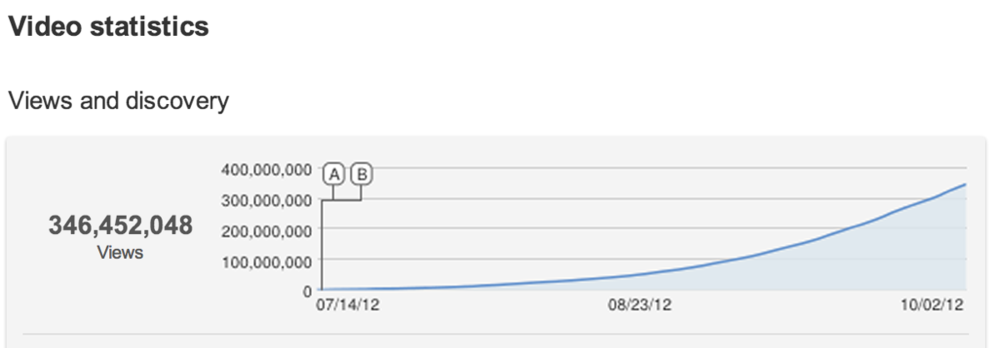
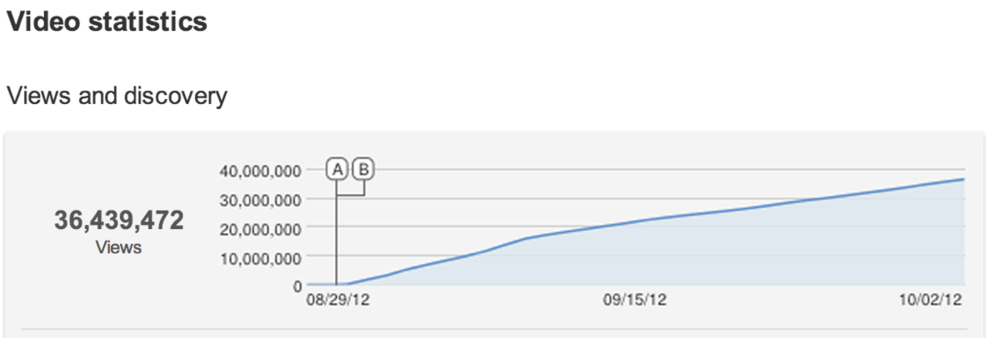
Gangnam style may be silly and funny, but it's traffic is hard to argue with and its disruption for traditional music marketing is waking up a bunch of people.  It is hard to argue with traffic stats like this.  Look at Gangnam Style vs. Taylor Swift's numbers and the shape of the curve.

NewImage 


NewImage

A Data Center Critic, NYTimes's James Glanz role in Industry

I've entertained the idea of writing content as a critic, but decided I didn't want that role.

a : one who expresses a reasoned opinion on any matter especially involving a judgment of its value, truth, righteousness, beauty, or technique

Being a critic is not fun.  At least I don't think it is fun.  Slate has a post on life as a critic.

Being a critic isn’t anyone’s childhood dream, an occupation that schools set out a booth for on Career Day, a religious calling that glimmers in the goldenrod.

...

To creatives, the Critic is the undermining inner voice maliciously put on the intercom to tell the whole world (or at least the tiny portion of it that still cares), You’re no good, you were never any good; your mother and I tried to warn you this novel was a mistake, but, no, you wouldn’t listen, Mister-Insists-He-Has-Something-to-Say. Failed artists consider critics failed artists like themselves, but worse, because unlike them they took the easy way out by not even trying to succeed, critics not having the guts to climb into that Teddy Roosevelt arena that everyone likes to invoke as the crucible of character, or risk the snows of Kilimanjaro.

...

Journalistic critics such as myself were, are, and forever will be routinely disparaged as parasites, sore losers, serial slashers, Texas tower snipers, and eunuchs at the orgy (what orgy? where is this orgy we seem to have missed?), which would hurt our feelings, if we brutes had any.

You can view NYTimes's James Glanz as a critic of the data center industry, pointing out areas where mistakes are made.

Being a critic means you are now a target for others to analyze your criticism.   Here is a post by a non data center person making an observation.  Larry starts off with a good skill of a critic, humor.

Stop The Presses: Computers Run On Electricity

By  Oct 2, 2012, 7:26 AM Author's Website

It is not easy for news organizations to support investigative journalism in this era of stagnant advertising, shrinking audiences and staff buyouts. So I’m not quite sure what to say to The New York Times for breaking the story that the Internet runs on electricity.

Thank you?

...

Most people probably don’t care, for the same reasons they don’t care about the nuts and bolts of all sorts of infrastructure. They just expect things to work.

The author identifies the hype factor.

Articles that lack a lot of news often resort to a lot of hype. This is especially apt to happen if a reporter has spent a year reporting a story that turns out to be not much of a story. And so it was with the first article in Glanz’s series, which resorted to straw men in order to drum up some excitement.

and how nuclear plants were added to the article, not natural gas powered plants or renewable energy plants to emphasize the evilness of data centers.

People are concerned about nuclear power, so nuclear power was worth mentioning. “Worldwide, the digital warehouses use about 30 billion watts of electricity, roughly equivalent to the output of 30 nuclear power plants, according to estimates industry experts compiled for The Times.” What about the equivalent output of windmills or solar panels? Would that be better?

Larry identifies that low utilization is an issue, but have you checked out the utilization of your PC lately?  People should be restricted to PCs that have a 50% utilization or higher.  No.  That is when an upgrade was long over due . If users can't stand a 50% utilization on their PCs or smartphones how can they tolerate a high utilization experience from the cloud?

The newspaper also devoted considerable space to the idea that most servers in a typical data farm are doing very little work most of the time. That’s true, and it’s inefficient, and it is probably avoidable in many situations. So the server farms’ inefficiency is a fair point to make, but it also inherent in most forms of computing.

If you check the metering program that is probably installed on your own PC, you will likely find that most of your computing power is being consumed by the “idle process.” The central processing unit is waiting around for someone to do something. Your disk drive also spends most of its time lazily spinning, waiting for a program to ask it to read or write some data. Each server in a server farm is a PC that has been stripped down to its basics: a CPU, a disk drive and a network card, all more powerful than the ones in a basic home computer. The servers have no screens and no keyboards. They wait until they are called upon to serve.

Larry make the point that the NYTimes does not have perspective.

The main thrust of the series is that server farms consume a lot of power, but how much, really? Perspective is sorely lacking. Glanz pointed out that server farms consume more power than the paper industry, as though the Internet is simply about displacing paper consumption. That leaves a lot of variables out of the equation.

And closes with a good point.

My guess is that the Internet, on the whole, has been as much an environmental boon as an economic one. I would be interested in an investigative series that tells me otherwise, but that isn’t the series that Glanz and The Times produced.

As with any young and fast-growing industry, efficiency takes a backseat to performance in the initial rush to keep up with demand. Fine-tuning for efficiency will come later. Right now, our greatest achievement is creating a world where users can get the data they want and need, wherever they are, whenever they want it. The Internet’s plumbing is about as newsworthy as that of the average sewage treatment plant, as long as they both do their intended jobs.

James Glanz has fulfilled the role of a data center critic, we'll see how many people are in line to do the same.  Roll call.  Anyone.  Anyone.  Anyone want to be a critic of the data center industry?

NYTimes Data Center articles miss the target, comments cut off, little traffic, truth in whose view?

I am sure many of you have discussions with your friends on the NYTimes infamous articles. I had friends call me, and it is dinner/bar conversation that inevitably comes up.

Here are some facts that you may like to use in a conversation.

The 1st and 2nd articles by Jim Glanz no longer accepts comments.  Huh?

Comments are no longer being accepted. Please submit a letter to the editor for print consideration.

There is a correction posted on Sept 24.

Correction: September 24, 2012

A previous version of this article misstated why Microsoft wasted millions of watts of electricity, according to records. It was an attempt to erase a $210,000 penalty the utility said the company owed for overestimating its power use, not underestimating its power use.

The NYTimes Public Editor has an article on balanced reporting and the pitfalls of "false equivalency".   The editor closes with a statement that is hard to believe is  a truth applied to the data center articles.

It ought to go without saying, but I’m going to say it anyway: Journalists need to make every effort to get beyond the spin and help readers know what to believe, to help them make their way through complicated and contentious subjects.

The more news organizations can state established truths and stand by them, the better off the readership — and the democracy — will be.

When you look at the last 7 days.

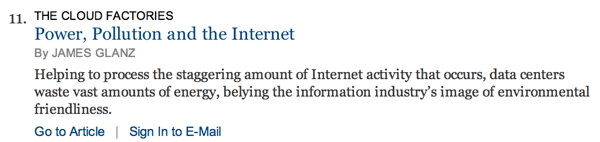
The most e-mailed shows the Power, Pollution and Internet at #11.

NewImage

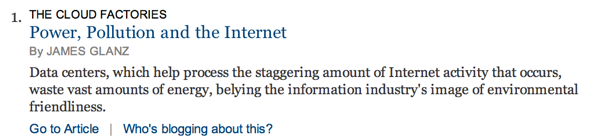
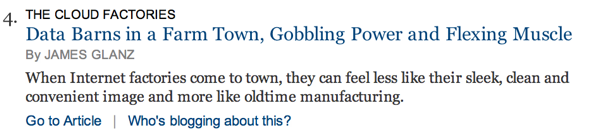
The article does get most blogged with #1 and #4 positions for the two articles

NewImage

NewImage

But the article doesn't make the Top 20 views for NYTimes overall or in Science over the last 7 days.

So this would seem like the articles stirred up the tech savvy data center community with e-mail forwarding and blog posts, but net didn't get that much traffic for the NYTimes.  

If you ran the NYTimes would you give the go ahead for more articles or not?

Why did the NYTimes cut off comments for both articles?


Why Renewable Energy is the Right Decision for Google's Green Data Center

Google was nice enough to let me know yesterday that they would make a renewable energy announcement today, and I have a bit of time to think about the impact of the announcement.

More renewable energy for our data centers

September 26, 2012
We announced our commitment to carbon neutrality back in 2007, and since then we’ve been finding ways to power our operations with as much renewable energy as possible. In our latest step toward this end, we just signed an agreement with the Grand River Dam Authority (GRDA) to green the energy supply to our Oklahoma data center with 48 MW of wind energy from the Canadian Hills Wind Project in Oklahoma, which is expected to come online later this year.
...
This brings the total amount of renewable energy for which Google has contracted to over 260 MW.

The press release went live at 7:00a PT this morning and as expected GigaOm's Katie Fehrenbacher and DatacenterKnowledge's Rich Miller put up posts quickly.

http://gigaom.com/cleantech/google-powers-a-data-center-with-wind-for-the-first-time/

http://www.datacenterknowledge.com/archives/2012/09/26/google-provisions-more-wind-power/

What comes to mind when I see Google's actions is a speech from UPS's Scott Davis Chairman and CEO about Right Turns at the Right Time.

Here are parts of the speech that support the idea of doing the Right Thing for the environment.

Why are so many companies struggling to survive, let alone grow in value?

 Making the right choices for the long time is part of his theme, and how it fits into sustainability.

I believe that some companies made expedient decisions¿ or took ill-advised shortcuts¿ that compromised their reputations, and in the long-term, their underlying value.

There is no question that this is a challenging economic environment. It's very tempting to take the quick, cost-cutting approach without carefully considering the impact on your company's reputation.

In the short time we have together today, I'd like to share my perspective on the vital role your company's reputation should play in your strategy and decisions.

I'd like to address two topics:

* First, why reputation should matter to every company, large and small, and why you should guard it zealously. Why, in my view, it's the bedrock of long-term profit, and sustainability.

* Second, what we can do to ensure that our companies' reputations do not become the victim in this belt-tightening environment . And

Why is this so important?  This is part of your brand and choices customers make.

Let me frame my comments by saying that reputation to me essentially means the degree of trust, admiration, and esteem that stakeholders have for a company.

Jeff Bezos, the CEO of Amazon, and someone I admire greatly, defines reputation in a more candid way : He says "reputation is what people say about you when you leave the room."

Yeh, yeh doing the right thing is important, but I am about the bottom line.  Well the bottom line is your reputation in the customers mind is worth billions of dollars, even to Google.

According to most reliable sources that study issues involving corporate reputation, the value of a company's reputation capital¿ its intangible assets such as brand equity, intellectual capital, and goodwill¿ is enormous.

It can constitute between 70-80%, and in some cases, such as Google and Coca Cola as much as 90% of a company's market value.

UPS's brand value has been placed as high as $21 billion dollars. That's "B" as in billions . . .

I see a few CFO's out there, and I can tell by the smiles on their faces that I just got their attention!

The environmental aspect is key to UPS's strategy.

We have implemented many environmental programs company-wide, but our efforts in this area are perhaps best illustrated by our initiatives relating to our vehicles.

For nearly 80 years, we've been focused on fuel conservation, long before it became the critical issue that it is today.
In the 1930s, for example, we pioneered the use of electric-powered vehicles in New York City.

Today we operate the world's largest fleet of low-emission vehicles, approximately 20,000 of them, and that number will continue to grow.

We also operate the largest alternative fuel-fleet in private industry. That includes natural gas, liquefied natural gas, propane, fuel cell, electric, hybrid electric, and hydraulic hybrid fleets.

Our entire delivery network has been re-engineered for more environmental benefit. You may have heard it described in the press as the UPS Right Turn Policy .

I can see a few of your smiling out there, and I know what you may be thinking¿ but it really works.

We carefully map-out routes for all our drivers to reduce the number of left-hand turns they make.

And, here is a statement that will really get your attention.

The bottom line for us is that our stakeholders need to know that when it comes to the environment, we intend to be part of the solution, not part of the problem.

Who would think that this is a speech that comes from UPS's CEO?

But when it involves your company's reputation, you have to have the courage for the long haul :

* The courage to cling to your convictions
* The courage to place reputation at the head of the line...Every Time!!
* The courage to maintain, despite all the howls of protest, clarity of purpose, and relentless focus on your company's reputation

Second, do the right thing at the right time . . . repeatedly.

...

In closing, let me leave you with this challenge: When it involves your company's reputation, do what's right over what's easy.

I hope this helps you look at how Google's Green Data Center efforts fit in an overall strategy and it is important enough to hit the Official Google Blog.

we’re a growing company with a corporate mandate to use clean energy for our operations in a scalable way.