Ferrari makes bold move, Limits email to three addresses, Encouraged to talk more, write less

It's been 7 years since I walked out of a corporate environment and one of the things I don't miss is the corporate e-mail system.  

NBCNews covered the move by Ferrari to limit email use in the company.  One of the things I find frustrating reading articles like this is where is the Ferrari statement referenced?  Many times journalists will make it appear like they talked to the company and have access to exclusive content. 

WSJ blog has a ahttp://blogs.wsj.com/corporate-intelligence/2013/07/05/ferraris-new-strategy-make-fewer-cars-send-fewer-emails/ that references Ferrari's statement.

In a bid to make them work more efficiently and effectively, the Italian maker of luxury sports cars and Formula 1 racers has a new email policy. Aimed at limiting the endless chain of reply-all emails that are a curse of office life, the new rule is pretty simple: An internal email can only be sent to a maximum of three people. According to a statement by the company:

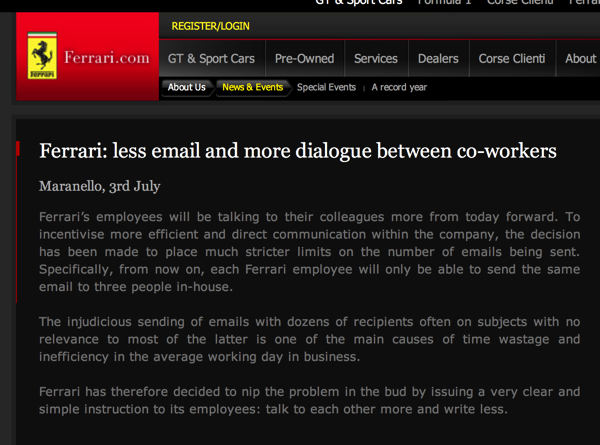
“The injudicious sending of emails with dozens of recipients often on subjects with no relevance to most of the latter is one of the main causes of time wastage and inefficiency in the average working day in business.

Ferrari has therefore decided to nip the problem in the bud by issuing a very clear and simple instruction to its employees: talk to each other more and write less.”

The Ferrari web site looks so much cooler too.
NewImage

The Ferrari statement closes with the main point.

Ferrari has therefore decided to nip the problem in the bud by issuing a very clear and simple instruction to its employees: talk to each other more and write less.

I would bet that Ferrari management is tired of resolving issues between departments where the groups don't talk to each other.  I would agree that writing is over rated.  

How many of the users of DCIM were asking for a new management approach?

I saw this DCK article that goes to nowhere.


Using DCIM to create a common data center management approach

Data Center Knowledge-by Bill Kleyman-6 hours agoShare
The modern data center is beginning to be considered the data center of everything. This means that more platforms, services and users are ...

Sorry, but we can't find that page ...


We're not able to find the file you are looking for. But we have more than 6,500 articles about data centers on our site, so we're sure it's here somewhere.

Got me thinking.  How many DCIM users want to create a new management approach?  Wouldn't people want software that supports the way they work and not force a change in management approach? 

This is why I when I wrote this post on DCIM and made the point that maybe the M in DCIM should be dropped.

Data Center Infrastructure Management.  Sometimes I think the solution would be better solved if the M - Management was dropped.  What is needed in Data Center Infrastructure.

Greenpeace praises Apple's Green Data Center efforts, shifting target to Amazon and Microsoft

Silicon Republic reports on Apple's latest solar project in Reno by interviewing Greenpeace's Gary Cook.

The good guys are.

"With Google, Facebook, and now Apple all announcing major new deals in recent months for new renewable energy to power their data-centre operations, the race to build an internet powered by renewable energy is clearly in full swing," he said.

The bad guys are.

"Microsoft and Amazon - both of which still power their internet using the dirty electricity that causes global warming - ought to take notice," he said.

"In the race for a clean internet, Apple is leaving both of those companies in the dust."

We'll see if Google, Facebook, and/or Apple get an advantage with a low carbon data center strategy.  They are all probably relieved that Greenpeace will focus on their competitors - Amazon and Microsoft.

Long Term Customer Satisfaction in a Data Center who are you focused on?

Here is a question.  Who are you focused on if you want to achieve long term customer satisfaction of a Data Center build or lease?

Most would focus on the decision makers of the initial project.  But, too many times the people who start the project are not the ones who live with the decision made.  And worse case the team making the initial data center choices are optimizing for their budget and internal visibility vs. the long term cost, operations, and availability of the data center.  Any problems in operations can easily be diverted by saying that the operations team is at fault, and the design was perfect.

I always watch out for those who make it seem like their designs are perfect and don't have issues.  Any good design has trade-offs.  And, some of those trade-offs may not be the ones you may make.  A high availability data center will have higher costs to build and operate.  An energy efficient design may have higher inlet temperatures which makes it hard for legacy systems to be accommodated.  There is no perfect car.  Especially for everyone.  There are no perfect data centers.  People are most proud of their acquisition within the first months and they talk about how it is the best data center as if they are Donald Trump showing his latest building.  After a year the novelty wears off.  

Except…  There are a set of people that will show off their data center years after it was commissioned.

Who?  The operations team who take pride in their work.  Those who had an active role during construction and have a loud voice in operations are way more likely to be proud of their data centers.  These are the people who will tell their peers about the vendors used, procedures, best practices, and the issues they have run into.  

If people spend more time focusing on the data center operations team then there is a good chance you'll increase customer satisfaction.

In the data center industry the big are getting bigger.  The small are folding their operations into the cloud.  The middle is silent as they get squeezed in markets, margin, and find it hard to compete. In this shift, the role of data center operations will grow.