Changing how you get Books to Learn more

There are some people who will not change the habit of reading printed books.  Many times these same people have to print something to read it.  They will make statements that they love the feel of the book and enjoy to hear the sound of the pages turn.  These same people probably miss the retail bookstores that used to be in all the malls.

I’ve watched the eBooks effort at Microsoft stumble, and when Amazon launched the Kindle some enthusiastic friends convinced me to buy one.  And, I now rarely buy a printed book, and for years accumulated a collection of Kindle eBooks.

There are some books that just don’t work on the Kindle.  Like Photography ones.  I would then turn to the Library and check out books.

I also went through the phase of putting the Kindle books on the smartphone and tablet.  Recently, I decided to get a Kindle Paperwhite, thinking that if I only read 10% faster it is worth it.  The best thing about the Paperwhite is when I read a book, I am less tempted to switch and read mail or surf the web.  I read and focus.

The other change I made is to stop buying Kindle eBooks.  I now buy a Kindle eBook maybe once every 3-4 months, sometimes less.  Amazon.com’s algorithms know what I am doing.  I choose to rent the Kindle eBooks from the Library, and rent 3-4 times the amount of books I used to buy just to try out different books.

I worked on all kinds of print technology - fonts, graphics, printers, high end RIPS, scanners so I know the technology.  Sometimes it is best to move on, and leave the technology behind.  The technology of printing and buying books.  

Amazon's Shipping opportunity for Private Delivery looks like what could be done with Hybrid Cloud

Much has been discussed on Hybrid Clouds.  One way to think about the problem of what should be in Public vs. Private cloud is what would Amazon do moving from Public Shipping companies to add capacity with a private delivery fleet.  Why?  Because sometimes thinking how to solve a problem from a different perspective can show you a different way to think about the problem.

If you were going to move some of your Cloud Compute out of AWS what should you move?  The easiest or the most valuable?  Another way to think is what could you move to your Private Cloud that would give you the most savings, leaving the rest to run in AWS.

Let me use local shipping as an example.  Here in Seattle UPS, Fedex and other local contract companies deliver packages for Amazon.  If Amazon was going to add private delivery to the mix what should they add?  Those thing that are the easiest?  Those things that are the most valuable?  You could, but that doesn’t necessarily get the maximum value out of a local private delivery service.  If Amazon has 10 trucks for routes and knows the shipments coming through, why not pick those shipments that can have the most savings vs. shipping with the Public carriers?  The complexity is a good problem for compute algorithms to calculate those shipments that can be handled in a day with the at the lowest cost and the most amount of freight saved.  This difference is what ends up in Amazon’s pocket at the end of the day, and provides future negotiating leverage with the Public Carriers.

Sometimes what people are thinking goes into a public cloud vs. private is not a clear financial reason.  If you cannot run it cheaper in house, then move it back to Public, and put something else in the private cloud. 

Just something that hit me after reading the Everything Store book.

The Everything Store: Jeff Bezos and the Age of Amazon [Kindle Edition]

Brad Stone 
4.3 out of 5 stars  See all reviews (308 customer reviews)

Print List Price: $28.00
Kindle Price: $10.99
You Save: $17.01 (61%)
Sold by: Hachette Book Group
NewImage

Amazon's James Hamilton throws in support for the idea of Blu Ray Cold storage

Facebook showed its proof of concept Blu Ray based cold storage solution at Open Compute Summit V.

Facebook has built a prototype system for storing petabytes on Blu-ray


36 MINS AGO

No Comments

 
SUMMARY:

During the Open Compute Summit in San Jose, Facebook VP of Engineering Jay Parikh shared some big statistics for the company’s cold storage efforts, including those for a protoytpe Blu-ray system capable of storing a petabyte of data today.

James Hamilton posts on the idea of optical storage.


Next week, Facebook will show work they have been doing in cold storage mostly driven by their massive image storage problem. At OCP Summit V an innovative low-cost archival storage hardware platform will be shown. Archival projects always catch my interest because the vast majority of the world’s data is cold, the percentage that is cold is growing quickly, and I find the purity of a nearly single dimensional engineering problem to be super interesting. Almost the only dimension of relevance in cold storage is cost. See Glacier: Engineering for Cold Data Storage in the Cloud for more on this market segment and how Amazon Glacier is addressing it in the cloud.


This Facebook hardware project is particularly interesting in that it’s based upon an optical media rather than tape. Tape economics come from a combination of very low cost media combined with only a small number of fairly expensive drives. The tape is moved back and forth between storage slots and the drives when needed by robots. Facebook is taking the same basic approach of using robotic systems to allow a small number of drives to support a large media pool. But, rather than using tape, they are leveraging the high volume Blu-ray disk market with the volume economics driven by consumer media applications. Expect to see over a Petabyte of Blu-ray disks supplied by a Japanese media manufacturer housed in a rack built by a robotic systems supplier.


I’m a huge believer in leveraging consumer component volumes to produce innovative, low-cost server-side solutions. Optical is particularly interesting in this application and I’m looking forwarding to seeing more of the details behind the new storage platform. It looks like very interesting work.

Mark Zuckerberg Shows up at Open Compute Summit V

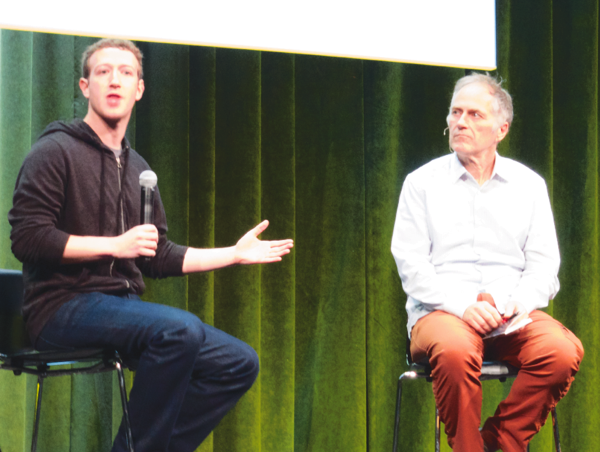
Mark Zuckerberg is the guest speaker, interviewed by Tim O’Reilly at Open Compute Summit V.  For the green data center crowd, Mark mentions the importance of data centers, energy efficiency and reducing the environmental impact.

NewImage

You’ll be able to watch the stream when it is archived.

  1. .@facebook's carbon savings in 1 year is the equivalent of taking 50,000 cars off the road for 1 year -Mark Zuckerberg at

  2. Since adopting OCP designs in 2011, Facebook has saved enough energy to power 40,000 homes for 1 whole year -Mark Zuckerberg at

  3. And...here's Mark Zuckerberg! Showing the flag for open source cloud computing.

    Retweeted by Open Compute Project

29 years ago I joined Apple in 1985, and you can see when all the Apple employees joined in order

An Apple friend texted me yesterday morning that she found my name in the list of Apple Employees just posted on Fri Jan 24, 2014.

NewImage

NewImage

I was just getting on a plane to SJ and we got a chance to catch up when I landed.  Her challenge was trying to find her name on the poster.  Knowing that I joined Apple in Mar 1985 helped her figure out where her name would be.  While looking out the window we saw Apple employees who probably weren’t even born when the Mac was shipped.  The summer of 1985 was when there layoffs due to slow sales of the Mac and hiring was quite slow for a year after I joined.  

Damn, feel old knowing I joined Apple 29 years ago. :-)

What is this list?  Apple created posters with all the Apple employees from #1 Steve Jobs and Steve Wozniak to the present.  I was lucky to have a friend find my name, saving me the effort to figure out how I would get to the right poster.  There are ten different ones in the employee areas. Maybe this a test for the ex-Apple employees whether you have a friend who is still at Apple and will spend the time to find your name.

Apple puts up celebratory posters with names of every Apple employee, past and present