USA Secretary of Interior Chooses Lake Sammamish as 1 of 8 Urban Wildlife Refuge Partnerships

There is a new (in 2013) Secretary of Interior who is the ex CEO of REI, HQ in Seattle.  Sammamish Review covers the Secretary of Interior’s visit to Lake Sammamish to announce the Urban Wildlife Refuge Initiative.

The partnership will help connect people in the Seattle metro-area to the great outdoors and, in particular, efforts to restore kokanee salmon runs in the Lake Sammamish Watershed.
“Children have become increasingly disconnected from nature,” Jewell said. “The Lake Sammamish Urban Wildlife Refuge Partnership seeks to reverse this trend by providing meaningful opportunities for urban residents in the region, especially young people, to get outdoors and engage in hands-on learning and conservation of kokanee salmon and its habitat.”

Below is a picture of Lake Sammamish looking to the South with Mt. Rainier in the background.  Where the little red rectangle is where I have lived for over 20 years.  Bald Eagles are regularly in trees.  Otters are in the lake eating crawfish.  And sometime in future hopefully more kokanee salmon.

NewImage

Going with RFID doesn't mean errors are gone, errors just show up in different places

A common perception is RFID is error free.  Airbus just announced it has an integrated RFID nameplate and in the press announcement is error-proof.

These tags will contribute to value-chain visibility, error-proof identification

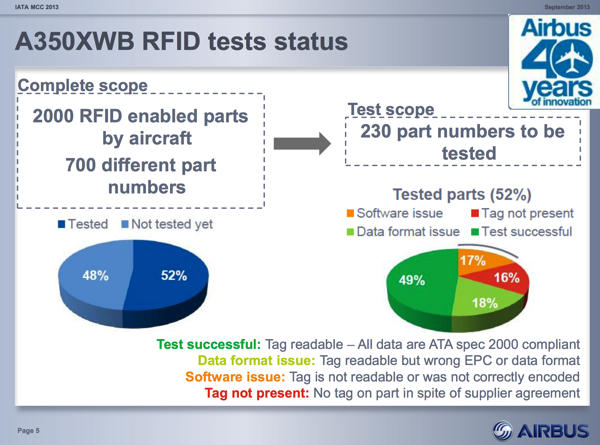
Keep in mind the media and marketing folks are not process engineers or software/hardware engineers.  Here is presentation by an Airbus engineer at a conference where errors are discussed.

NewImage

A lot of things need to happen that people don’t think about.  Now you could argue that this was a test.  But with 51% error rate, how long will it take the error rate to be below 0.1%?  To get lower error rates you need to put in audit systems to find errors and reconcile them.

One of the problems Airbus and I think Boeing has is they are storing data on the RFID tags which by the way is the craziest damn idea.  Now it may seem like a good idea to store the data on the device.  Imagine having 10,000 eventually 100,0000 or 1,000,000 RFID tags with data stored on them, syncing the data from all those devices will create a data management nightmare.  Tags get damaged.  Remote devices don’t sync data.  They get bad data written to them.  How do you handle security access to write data to the device.  Read from the device.  Can just anyone walk into an airplane equipment and collecting data on the devices that respond to RFID?  Secure organizations prohibit USB devices.

Even though I am discussing RFID, many of these same issues apply to any kind of monitoring system.  Errors exist in all kinds of systems.  To reduce errors no different than reducing downtimes at some point can be addressed with redundancy.  Having multiple data feeds for the same thing reduces the chance of errors.


Don't Think Social Issues are Important in the work place? Social Threats are close to Physical Threats

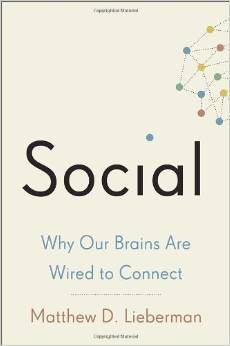
The latest book I am reading is Social by Matthew B. Lieberman

NewImage

Two points made that can open your mind up.

Our brains evolved to experience threats to our social connections in much the same way they experience physical pain .

We intuitively believe social and physical pain are radically different kinds of experiences, yet the way our brains treat them suggests that they are more similar than we imagine.

Lieberman, Matthew D. (2013-10-08). Social: Why Our Brains Are Wired to Connect (p. 5). Crown Publishing Group. Kindle Edition.

So much of work and school thinks being social is bad and a distraction, but you cannot turn off being social.

Based on the latest cutting edge research, the findings in Social have important real-world implications.  Our schools and businesses, for example, attempt to minimalize social distractions.  But this is exactly the wrong thing to do to encourage engagement and learning, and literally shuts down the social brain, leaving powerful neuro-cognitive resources untapped. 

Writing for Your Friends Makes More Friends

A year ago I wrote a post on why I write.  Orwell says that we write for Sheer Egoism, Aesthetic Enthusiasm, Historical Impulse, and/or Political Purpose.  I think there is another reason to write. 

Many years ago I sat next to my dear departed friend Olivier Sanche for the first of many dinners.  One of the people at the table said Dave has a blog.  Olivier said he loves to read blogs.  Can I give him the url for mine?  I gave him my card.  Surprised he said this is you.  You are the writer for the Green Data Center Blog?  I read it every day and I send links all the time to my team.  Months later Olivier and I were chatting and I mentioned a post I had written, and he clarified, “Dave, I read everything you write.”  When I would meet with others on his team we would have speed conversations because they had been reading what I was writing and we were discussing the actions to take.  Sometimes, well many times my head would spin because I needed to remember my past posts, recall them, and then slip back into the conversation.  It is kind of embarrassing that you can’t recall what you had written over the past couple of weeks. :-)

To this day so much of what I write is what I would want to say knowing Olivier would read my posts.  This style, writing for my friends feels natural, and it has many other benefits including making new friends is many times easier as people feel like they know me.

Who are my friends who I think of?  It’s been 34 years in the tech industry.  My friends are all over - Google, Microsoft, Amazon, Facebook, Twitter, Intuit, Apple, Dell, Intel, media companies, PR companies, data center companies, construction, cloud, software. 

Will I stop?  I don’t think I can as long as I have friends who remind me of something I wrote a month ago and how useful it was.  Heck I have people tell me a post I wrote a year ago is helping them educate users.  My memory gets really foggy trying to remember posts over a year old. ;-)


Yevginey Sevlik and others at Data Center Knowledge shift roles

The data center industry has seen changes and the media world shifts as well.  Recent LinkedIn updates show DatacenterKnowledge has a new editor in chief.


Yevgeniy Sverdlik has a new job.
Now Editor in Chief at Data Center Knowledge.
 
 Say congrats
 
Rich Miller has a new job.
Now Editor at Large at Data Center Knowledge.
 
 Say congrats
 

Matt Stansberry used to work for Tech Target, and is now with Uptime.

Kevin Heslin used to work for Mission Critical, and is now with Uptime.

DatacenterKnowledge is part of the iNet Interactive company which includes AFCOM and Data Center World.

AFCOM

AFCOM

AFCOM is the leading association supporting the educational and professional development needs of data center professionals around the globe. Established in 1980, AFCOM currently boasts more than 4,500 member data centers and 40 chapters worldwide, and provides data center professionals with unique networking opportunities and educational forums and resources through its bi-annual Data Center World Conferences, published magazines, regional chapters, research and hotline services, and industry alliances.


DATA CENTER KNOWLEDGE

Date Center Knowledge

Since 2005, Data Center Knowledge has provided senior IT and operations professionals, who build and manage data centers, daily news and analysis about the industry. It covers the latest developments and trends driving the powerful growth in demand for mission-critical facilities, the challenges and opportunities presented by high-density computing and its impact on power and cooling, and the evolution of the industry to include cloud computing and modular data centers.


DATA CENTER WORLD

Data Center World

Data Center World, operated by AFCOM, is the industry’s premier networking and educational conference. Thousands of data center and facility management professionals, from many of the largest corporations, government organizations, and academic institutions in the world attend Data Center World to share, discuss and learn about the latest data center products, trends, technologies, and best practices.

 Uptime Institute has research, publications, and events.  Uptime is owned by 451 Group.

Gartner has its research, publications and events.

The big three in data center media are iNet Interactive vs. 451/Uptime vs. Gartner competing for advertisers dollars who spend money on publications, research, and events.