Army says they are shutting more Data Centers than other Federal Agencies

Saw this post on Federal Times on the US Army moving data center capacity.  This paragraph makes an interesting claim.

“We’re aggressively shutting down data centers. I don’t think there’s anyone in the federal government that is shutting down as many data centers as the Army is,” Krieger said May 6 at the C4ISR & Networks conference in Arlington, Va. “But this is not a data center drill; this is about applications. This is about modernizing, virtualizing and moving.”

Hosting 50 Women For Hamlin Robinson School Auction Item

Our son goes to Hamlin Robinson, a school targeted for those who have dyslexia and other language-based learning differences.  We have donated a variety items for the school auction like a dinner party at our house.  This year my wives friends decided to donate an evening for mom’s to get together.  I figured a dozen people when someone bids for the item and invites her friends.  The auctioneer read the description and auctioned individual attendance to get as many people as she could to bid $75/each for an evening with other mom’s for cocktails.  Well 50 people bid.

NewImage

NewImage

We have lots of help including our kids and some of their friends.

NewImage

The weather wasn’t that bad, a bit of rain, a bit chilly which is why we have a tent and fire pit.

NewImage

NewImage

We had plenty of food and I cooked 7 pizzas.

NewImage

NewImage

NewImage

Here are the hosts.

NewImage


Digital Innovation Newspapers vs. Music Industry

Two old industries that have had the impact of the digital age hit them are Newspapers and Music.  The Music industry went digital with CDs, then MP3 ripping and digital distribution pretty much destroyed the business models of selling albums.  Newspapers have been hit from two sides.  The wealth of choice in getting the news, and the changes in advertising and running classified ads.  What to do?  Here are two different comparisons.  Music is having record revenues if you bet on live-music.  Newspapers are still trying to figure out the new way to make record revenues.

WSJ reports on the Live-Music industry and their hot summer.


The Concert Industry's Big Hot Summer

The live-music business is predicting a record-breaking summer with big tours by Beyoncé and Jay Z, Eminem and Rihanna, George Strait and Outkast

Technology is changing the Music events and making them more money.

Technology is also changing the concert-going experience. Live Nation, which now sells 16% of its tickets on mobile devices, is testing and integrating an app that allows fans to reserve lawn chairs, skip entry lines and access VIP areas using their phones. At more festivals, fans will be able to leave their credit cards at home and purchase food, drinks and merchandise with chip-embedded wristbands, such as those designed by Front Gate Tickets. At Bonnaroo, fans can use the festival's official app to find their friends and live-stream shows from the bathroom lines.

The music industry has been following the money.

Lucrative album sales are now a thing of the past and Internet buzz doesn't always translate into revenue. With acts reliant on touring for their income, many are working harder to put on better shows, says Live Nation's head of global talent, David Zedeck.

GigaOm’s Matthew Ingram reports on the NYTimes

Internal innovation report says the New York Times needs to up its digital game or else


3 HOURS AGO

1 Comment

NYT newspapers
photo: Getty Images / Mario Tama
SUMMARY:

An internal report that looked at how the New York Times is performing in terms of its digital strategy says the paper needs to focus a lot more on audience engagement and analytics — but can it take the steps necessary to disrupt its traditional culture?

When I read about the NYTimes it seems like the publisher has trouble hearing what the audience wants.  The competition has figured out how to listen to readers.

“Start-ups like Vox and First Look Media, backed by venture capital and personal fortunes, are creating newsrooms custom-built for the digital world. BuzzFeed, Facebook and LinkedIn are pushing deeper into the journalism business by hiring editors and unveiling new products aimed at newsreaders. Traditional competitors like The Wall Street Journal, The Washington Post, The Financial Times and The Guardian are moving aggressively to remake themselves as digital first.”


Video Cameras Enable Policing the Police Force, Changing the Enforcement Game

Arstechnica posts on London deploying video cameras in some of its workforce.


London police will soon wear video cameras

Manufacturer says cameras are a "game changer," cops not so excited.

Taser is behind the video cameras.

Taser has indicated that London's test is the largest such urban pilot anywhere in the world. Two response teams on each borough will be suited with such cameras when answering emergency 999 calls during the pilot. The findings of the pilot will be used to determine future implementation of such technologies.

"Our Axon body-worn cameras are a game changer for law enforcement agencies worldwide and are helping police officers reduce crime and build safer communities,” Jeff Kukowski, Taser International’s chief operating officer, told Ars. “When you look at community safety today, there are any number of scenarios where there is controversy. Video helps pool together what happens."

Opening Your Eyes Delivers 40% of Your Perception, The Rest Is From Your Memories or Patterns

Lately I have working on software for operations and part of what hit me is this point from Creativity Inc by Ed Catmull.

Pete Docter’s ambitious film that would eventually become known as Inside Out. During the intensive research phase of the film, Pete was surprised to hear from a neuroscientist that only about 40 percent of what we think we “see” comes in through our eyes. “The rest is made up from memory or patterns that we recognize from past experience,” he told me.

Animators have been trained to be observant— they know that viewers subconsciously register even the most subtle motions and that those, in turn, trigger recognition. If animators want a character to reach for something to their left, they anticipate that a split-second earlier by having the character move ever so subtly to the right. While most people aren’t aware of it, this is what the brain expects to see— it’s a tell, if you will, that signals what’s to come. We can use that tell to guide the audience’s eyes wherever we want them to look. Or conversely, if we want to surprise people, we can leave it out, making the unforeseen motion more startling. In Toy Story 2, for example, when Jessie talks about her fears, she twists one of her braids around her finger. Seeing this little motion, you sense her state of mind, perhaps without even knowing why. The meaning in that simple action is supplied by the audience , though —by their own experiences and emotional intelligence.

Catmull, Ed; Wallace, Amy (2014-04-08). Creativity, Inc.: Overcoming the Unseen Forces That Stand in the Way of True Inspiration (Kindle Locations 2767-2776). Random House Publishing Group. Kindle Edition.

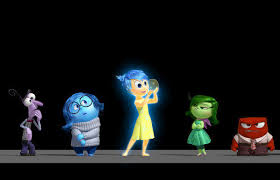
Here is the movie that Pete Docter was researching for.

NewImage


Inside Out

U.S. Release Date: June 19, 2015

From the tepuis of South America to a monster-filled metropolis, Academy Award®-winning director Pete Docter has taken audiences to unique and imaginative places. In 2015, he will take us to the most extraordinary location of all - inside the mind of an 11-year-old named Riley. 

Growing up can be a bumpy road, and it's no exception for Riley, who is uprooted from her Midwest life when her father starts a new job in San Francisco. Like all of us, Riley is guided by her emotions – Joy (Amy Poehler), Fear (Bill Hader), Anger (Lewis Black), Disgust (Mindy Kaling) and Sadness (Phyllis Smith). The emotions live in Headquarters, the control center inside Riley’s mind, where they help advise her through everyday life. As Riley and her emotions struggle to adjust to a new life in San Francisco, turmoil ensues in Headquarters. Although Joy, Riley's main and most important emotion, tries to keep things positive, the emotions conflict on how best to navigate a new city,
house and school.

Director:  Pete Docter
Co-Director: Ronnie del Carmen
Producer:  Jonas Riveras