Helmet Cam hardware for Remote Data Center Operations

The momentum for the helmet cam idea for remote data center operations continues to grow.  My friend who started the solution 3 months ago is buying three more sets of hardware.

When you think Helmet Cam you may be thinking images like this.

image

Well what it looks like is this.

2010-07-30 14.43.04

2010-07-30 14.44.52

There are three pieces of hardware - the wireless helmet camera, the Bluetooth noise cancelling headset, and a video streaming server.

As soon as I have video that is approved for posting,  I'll post again.  And soon I'll provide the list of hardware used.

There are a handful of people I am working with to continue the evaluation.  If you think you want to be an early adopter, you can contact me.

Read more

Attending Lee Tech on Tap in Chicago - Aug 5, 2010

Thanks to the folks at Lee Technologies I was extended an invite to attend the Lee Tech on Tap event in Chicago on Aug 5, 2010.  I've written about the event so much, it will be good to see the people and event in person.

I would live blog the event, but I think I'll be too busy talking to people.  I don't expect any press releases surrounding the event so there is no need to hurry and post.

image

As the event is hosted in an Irish Pub, I am sure I will get the question isn't your name Ohara Irish.

I’ve been to Ireland many times visiting Apple and Microsoft facilities, and my name Dave Ohara so many times my name gets spelled with an apostrophe (like O’Hara).  But I am not Irish even though I have kissed the Blarney stone and bought a family crest for my Dad of O’Hara.  My Ohara surname is Japanese, but I still enjoy Ireland.  I don’t have this problem when I go to Japan. :-)

Ohara is a Japanese surname (e. g.: 小原,尾原,大原)

For those of you attending, I'll probably be one of the few Japanese Americans there, so I should be easy to spot.

Here are a list of things I am looking for:

  1. Why people like the event and how it compares to other data center events?
  2. What are top issues/problems that people think need to be addressed in data centers?
  3. What do people think of the helmet cam idea?
  4. What should I be blogging more about?
  5. Do people think Green is an issue for data centers?

I'll be at the event early and staying late.

Read more

Managing a Sustainable Online Community

A friend posted a line to this post on how to manage a sustainable online community which is one of the greener ways to leverage cloud services in a data center.

And these are good things to think about if you want to get involved in social data center networks.

HOW TO: Manage a Sustainable Online Community

Community Network ImageRob Howard is the CTO/founder of enterprise collaboration software company Telligent.

A 2008 Gartner study on social software noted that “about 70 percent of the community typically fails to coalesce.” While the measurement and the statistics behind this statement raise questions, there is an element of truth.

The popularity of the post is high.

image

I've read the article a few times to think about to leverage the ideas, and completely missed the author's name, Rob Howard.

Rob Howard, Founder and CTO

Rob Howard is the vision behind Telligent's product development and innovation and is known throughout the industry as an authority in community and collaboration software. As Telligent's Founder and Chief Technology Officer, Howard oversees product development and the company's technology roadmap. A true pioneer, Howard contributed to the development and adoption of Microsoft's Web platform technologies, where he helped create and grow the innovative ASP.NET community. In 2004, he continued his vision for customer engagement when he founded Telligent, which was first-to-market with integrated online community software. Howard also understood early on the value of community analytics, and Telligent was first-to-market with an application to address this need.

I worked with Rob at Microsoft and it is great to see he has a successful company focusing on collaboration.  Now that I have a connection with the author I am reading the post with a different perspective.

Rob makes three excellent mistakes in online communities.

There are detrimental effects of over-hyping the technology and then committing the three cardinal sins of running a community:

  • If you build it they will come. This is probably the best known online community fallacy. The premise is that if I roll out a given technology set (blogs, forums, wikis, etc.), users will automatically appear and congregate, forming a robust community. This can be attributed to the lure of “social software” that companies repeatedly bite at, as opposed to seeking to extend or create value for their customers.
  • Once I’ve launched it, I’m done. Many communities launch successfully, only to fade out and disappear. This is due in large part to a failure to assign ownership of the community and to have a strategy that lasts past “launch.”
  • Bigger is better. The assumption here is that the overall size of a community is indicative of its success. This is challenging for most community managers and businesses to understand, as it is contrary to what they’ve usually been told.

And discusses the relationship of the size of a group and benefit to end users.

Community life cycles are often portrayed as simple linear progressions, with the goal of “maintenance” once maturity is reached. However, I have found that a community has unique characteristics that conflict with many of the preconceived notions of success. While the value of the community to its creators increases as membership increases, the value to individual members may diminish. Disregard for, or lack of understanding of these behaviors can lead to the failure of a community.

Analogies have been made to high schools and sub groups that exist.

It should be noted that I am not advocating that communities be limited by membership size. Rather, capabilities should exist within a larger community to support smaller, internal groups that can form around narrow areas of interest. This is validated by both Twitter and FacebookFacebook, which have in recent months both introduced capabilities to narrow the scope of conversations: Lists, privacy controls, and so on.

Read more

Warning an obsession on operational efficiency can lead you to anorexia vs. being competitive

We have all been frustrated by a bean counter approach that focus on the numbers.  Where a short term cost reduction is viewed as a win, even though your long term health suffers.

An example of a potential obsession on a data center efficiency number is PUE.  PUE is often used as identifying a green data center, but PUE is only one number and not the end goal.

The Phoenix Principle has a guest blog post that touches on the Yin and Yang of Operational Excellence.

The Yin & Yang of Operational Excellence & Innovation

Efficiency is a good thing, taken in moderation. The same with focus. It is good management hygiene to pay attention to what you’re doing and try to do it efficiently. This helps build a competitive cost structure and a results-based culture. From an operations standpoint that means that the use of an occasional stopwatch or its modern day equivalents in order to eliminate wasted effort and speed workflows makes perfect sense. Frederick Taylor made the great contribution in 1911 of helping companies recognize that labor is a controllable cost that can be managed, but he taught that a narrow focus on the optimization of each operation and repetition of the “best practice” was the key to success. He missed the point (among others) that it is really the improvement of the process as a whole that changes the game. It took Toyota and Yamaha and other Japanese companies to teach the world that lesson 70 years later – leading to today’s six sigma, lean, and time compression concepts.

One of the points well made is an obsession that can occur when management focuses on efficiency as the end.

The pursuit (often obsession) of operational excellence becomes an end unto itself and gets disconnected from the mission of generating growth and creating value.

How many companies are limited by its IT group and data center capacity?

The end game is not to get lean and agile, but rather to get lean and agile so that you can compete more effectively – leveraging these capabilities to go to market in innovative new ways, to compete in new markets, and ultimately to create new markets.

Which is part of why cloud computing solutions like AWS are successful as companies can side step the corporate IT/data center group as they don't want to incur any new costs.

Be careful trying to be too efficient and miss the focus on supporting the business.

Do you have an accurate image of yourself?

Read more

Solar renewable energy generation drives desert areas closer to Peak Water

WSJ has an opinion article on Peak Water issues caused by solar power mandates.  For more in depth of the comparison of the term Peak Water vs. Peak Oil check out this pdf.

Peak Water
Meena Palaniappan and Peter H. Gleick


In the past few years, discussions about the possibility of resource crises around water, energy, and food have introduced new terms and concepts into the public debate. Energy experts predict that the world is approaching, or has even passed, the point of maximum production of oil, or “peak oil.” The implications of reaching this point for energy policy are profound, for a range of economic, political, and environmental reasons. More recently, there has been a growing discussion of whether we are also approaching a comparable point of “peak water,” at which we run up against natural limits to availability or human use of freshwater.

Back to the WSJ Article.

Peak Water

An unintended consequence of solar power mandates.

Harry Reid has decided that Senate Democrats will put off their cap-and-tax energy ambitions for now, focusing on smaller-scale subsidies and mandates. Anyone who thinks this counts as a "compromise" might visit Arizona, where the green campaign for renewable energy is forcing the state to confront the limits of a nonrenewable resource—water.

With more than 10 months of sun a year and vast tracts of desert, Arizona is seemingly ideal for solar power, aside from the fact that solar isn't cost-competitive with conventional fuels. So, in a preview of the "renewable portfolio standard" that Democrats want to impose nationwide, the state mandated that utilities produce 15% of their electricity from green sources by 2025. Scores of solar projects are thus under review by federal and state regulators, with some of the applications fast-tracked so developers can qualify for tax credits in the stimulus.
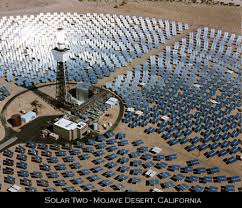
What is not common public knowledge is the relationship between energy and water in power production.  Australia has a study that shows the relationship that I posted on last year.  I think the Australians learned this as part of when a desalination plant was built to be powered by a coal power plant.  You can guess when you account for the fresh water use by the power plant, the amount of energy required to generate fresh water through desalination, the economics and environmental impact didn't work.

Looking at the big picture of the relationship between water and solar power is in the WSJ article.

One hitch: The hot, arid regions best suited for solar also tend to be short on fresh water, and Arizona is no exception. Utility-scale solar power works by generating steam that spins turbines. Cooling the system at the end of the process consumes almost twice as much water per megawatt hour as coal-fired power plants that use the same cooling technology, according to a 2009 report from the Congressional Research Service. The study, which examined the consequences of a solar expansion in the southwest, adds that it could consume as much as 1% of the state's finite water resources within a few years.

The environmentalists answer is to not use steam, but photovoltaic.

Environmentalists say other solar methods require less water, but these aren't as efficient for generating power and they raise costs even more than the usual solar process. At any rate, Arizona is already an electricity exporter, mostly to California, so it isn't as if energy is in short supply. The state's green regulations are effectively a mandate to export water, which is in short supply.

The greens also claim that advanced photovoltaic solar farms (which convert sunlight directly into electricity with de minimis water) are just around the corner. But photovoltaic technology is no closer to commercial scale than cellulosic ethanol, plug-in vehicles and the other "second generation" science projects that environmentalists claim are just five years off to excuse the shortcomings of technologies as they exist today. They're always just five years off no matter what year it is, in order to justify continued subsidies.

Issues like this are why I say it is difficult to define a green data center.  A better method is to take the steps to make things greener. 

Green energy has been sold as a great free lunch, promising millions of new jobs and cheap electricity, but somehow it never turns out that way when you look under the hood.

The greenest data center is the one that doesn't exist and has no environmental impact.  But, I am not going to take that radical environmentalist view.  Cloud computing getting people to be charged for their usage in real-time is a great step to get people to see the costs of their technical and business decisions to run information services.

Read more