Transitioning from assumption of Secrecy to public exposure snares top dogs, College football is an example

Data Center is an industry where most assume secrecy is a standard practice.  Secrecy makes life easier as many can do things that aren’t known to the public.  But, with Facebook, Twitter, and many other social sites documenting people’s actions, it is harder to keep things secret.  One of the latest examples in College Football’s Ohio St football coach Jim Tressel.

The WSJ article reviews the situation.

The Sport That Can't Keep a Secret

College Football's Sins Keep Getting Publicly Exposed—But Isn't Sunlight a Disinfectant?

By DARREN EVERSON

The public shaming of Ohio State football coach Jim Tressel is the latest in a series of revelations that have touched nearly all the top programs in college football and many of the sport's most prominent stars.

[tressel0310]Photo Illustration by The Wall Street Journal; Zuma Press

The recent suspension of Ohio State football coach Jim Tressel points to a complex truth.

The long trail of investigations, accusations, clarifications and statements of heartfelt contrition has cut from North Carolina to Oregon in recent months, scooping up national champions, famous coaches and Heisman Trophy winners.

Some see the openness as a good change.

The obvious conclusion to draw is that college football's moral center has been replaced with a delicious filling of creamy marzipan. (Good luck finding someone who would argue the other side). But the events of recent days also point to another, more complex truth: College football is becoming an impossible place to keep secrets.

"The more transparency, the more openness the better," said former Michigan athletic director Bill Martin. "I think this is all very healthy."

The NCAA has an impossible task to try and monitor football let alone all college athletics, but their life is much easier thanks to web properties like Facebook, Twitter, and TMZ.com.

In the last year, NCAA investigators have been drawn to ask questions about everything from a report on TMZ.com that a player was at a party sponsored by an agent to a Facebook post in which one heavily recruited high school player posted about his new iPhone.

There have been controversies generated by reports of players who've been spotted in fancy cars. And because most schools are public institutions supported by taxpayers, they're required to respond to requests for information made under the Freedom of Information Act.

The mood is changing to help the NCAA catch the illegal action.

Beyond enforcement, however, there's a growing consensus throughout college football that the NCAA is simply doing a better job of collecting information. "In the past, the NCAA was often criticized for not knowing what's going on in the real world," Baker said. "I think we've got a pretty good idea. Coaches and players are starting to realize that as well."

What's often forgotten is that the immense popularity of college football, the intensity of its rivalries and the increasing interconnections of its fans, have created another potent police force. The result: more messes are being exposed. But the sport is also seeing more than its share of sunlight. And as Justice Louis Brandeis said, "Sunlight is the best disinfectant."

"I don't know that things are a lot different—it's just that people are turning in schools now that weren't before," said Gary Barnett, the former Northwestern and Colorado coach. "It really comes down to all of the hype that's around this sport. The hype is involved, therefore the interest is involved, and people are willing to come forward."

In the future there is going to be a data center disaster that will break the code of secrecy in a location.  What type of event?  Imagine if there was a loss of life due to a data center going down or a data center is proven to be the center of criminal activity.  An investigation into the data center could bring out a bunch of people who were witnesses to illegal activities.  What kind?  Watch where the money flows.

Ironically what could snare some of the top dogs is how they are proven to know of the inappropriate activity, but as long as the data center was running it is not a priority.  Ethics in the data center should help transparency and openness which also makes it easier to green the data center.

Are bits evacuating Japan? How geo redundant are the systems?

I’ve been talking to some friends and being risk adverse, there are some people who are working to move their bits off servers in Japan.

As DataCenterKnowledge reports, there is no immediate impact to data centers in Tokyo.

Major Tokyo Data Centers Fuel Up for Blackouts

March 14th, 2011 : Rich Miller

Major data centers in Tokyo say they are undamaged ready to continue operating, even if they lose utility power due to a program of rolling blackouts being implemented by Tokyo Electric Power Co. (TEPCO). Some forecasts say the power rationing could continue for weeks or months, placing a premium on access to diesel fuel to maintain services during outages. Some companies are voluntarily powering down non-critical data center operations, including Sony, which is turning off its Final Fantasy online games for at least a week.

GigaOm reports on possible damage to undersea cables.

In Japan, Many Undersea Cables Are Damaged

By Om Malik Mar. 14, 2011, 10:34am PT 2 Comments

The horrific earthquake and the ensuing tsunami in Japan have caused widespread damage to undersea communications, according to data collected by telecom industry sources. Initially, it was thought that the damage to the cables that connect Japan and Asia to each other and other parts of the world was limited, but new data shows the extent of the problems.

And, WSJ does a great job of summarizing efforts in the rest of Asia in addition to Japan.

About half of the existing cables running across the Pacific are damaged and "a lot of people are feeling a little bit of slowing down of Internet traffic going to the United States," said Bill Barney, chief executive of Hong Kong-based cable-network operator Pacnet. He declined to name the damaged cables operated by other companies, but said Pacnet's cable system connecting Japan to the U.S. isn't damaged so far.

But with the risk of data loss going up substantially in the operating data centers, what isn’t being discussed is are bits being moved out of Japan’s data centers to other locations.  With Fiber and Power access a risk, let alone another earthquake or Japan’s infrastructure being reprioritized, there are some who are making plans for a Japan data center going offline.  The ones who can do this are the ones with geo redundancy and spare capacity in other countries.

At this time should data centers and servers be turned off in Japan that can move to other areas?  Power and water are now critical resources in Japan along with diesel fuel.

Writing Process, an example of what I didn’t blog

I just spent the past week working on a newsworthy blog post.  After a week the person who I was working with and I agreed it was not appropriate to post.  Now some of you may find this extremely frustrating, spending all the time writing, editing, rewriting, obsessing, and repeating the process.  But, in the end I feel better we both agreed not to post. 

WSJ has an article by a creative writing teacher.

Novel Ideas: Write. Rewrite. Obsess. Repeat

By HELEN SCHULMAN

Part of my job as a teacher of creative writing is to curate a reading series for our students and the interested public. We often get great writers to come share their work and to talk about anything from the sources of their inspiration to the books on their bedside tables.

During the question-and-answer period, however, the discussion almost always turns to process: Our audience wants to know every detail of how an author actually sits down to write a book. In writing fiction, there is the mystical element that none of us ever quite understands—how we turn language and ideas into stories and then, hopefully, into art.

Helen discusses the different ways people write, making the point each comes up with their own personal rules of process.

And so, to gird themselves against the anxiety of this fraught endeavor, writers often come up with their own personal rules of process. Think of it as a means of self-discipline, with a dollop of magical thinking and even obsessive-compulsive disorder thrown in to keep the spirit afloat.

Which brings up one of the rules of why I write.  I write because it supports my learning by making me write why I think something is important, and think about the effects of what I post.  Another rule is I always require permission to post or the content is already publicly disclosed.

So going back to the effort I spent the past week on writing a post that I didn’t post.  I feel good, because I learned things about the person, how to write on a topic that would be picked up in news, and about myself.  And, as Helen mentions.

Think of it as a means of self-discipline, with a dollop of magical thinking and even obsessive-compulsive disorder thrown in to keep the spirit afloat.

My spirit does feel better sharing that I didn’t post. Smile

Google launches People Finder for 2011 Japan Earthquake, Data Centers are key infrastructure to support disaster recovery

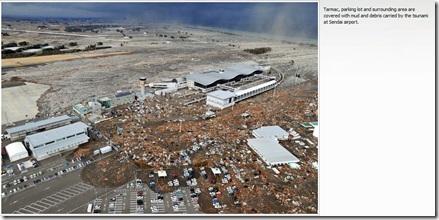
Japan had a magnitude 8.9 earthquake with some of the worse damage in Sendai.  Here are pictures on MSNBC.  I used to take regular trips to Sendai, visiting Sony’s manufacturing facility, and it is was quite sad to see the damage.

image

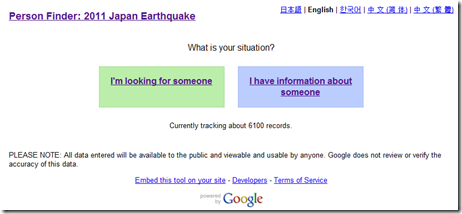
Google has launched a version of People Finder for the Japan Earthquake that is available in Japanese, English, Korean, simplified and traditional Chinese.  I am thinking of friends who are in Tokyo and hope they are well.

image

Nuclear Power plants are being shut down due to cooling system damage, fires, or lack of electricity to run cooling systems, but no nuclear leaks.  Here are some excerpts from MSNBC’s worldblog.

5:06 a.m. ET:  A Japanese utility reports a fire at turbine building at a nuclear power plant in northeastern Japan, the AP reports.

6:07 a.m. ET:  Government has no information on radioactive leakage, government minister says, according to NHK World.

5:44 a.m. ET:  Nuclear power plant administrator in northern Japan says process for cooling reactor is "not going as planned," adding that "nuclear emergency situation" has been declared.  Asks people nearby to stay calm, NHK World reports.  Also says that American military has offered to help.

6:29 a.m. ET:  Chief Cabinet Secretary Yukio Edano says the nuclear power plant in Fukushima developed a mechanical failure in the system needed to cool the reactor after it was shut down in the earthquake.  He said the measure was a precaution.

7:28 a.m. ET:  The International Atomic Energy Agency says it is looking for more information on the condition of Fukushima nuclear reactor buildings and cooling systems, Reuters reports. Meanwhile, Japanese authorities say that fire at Onagawa nuclear plant has been extinguished.

8:48 a.m. ET: The Japanese government has declared an emergency situation at one of Tokyo Electric Power company's nuclear power plants in quake-stricken Fukushima Prefecture, NHK reports. It says no radioactive materials have been leaked. But Tokyo Electric said an equipment failure has made it impossible to cool two reactors at the Fukushima Number One plant. The firm says it does not have enough electric power to cool the reactors, which automatically stopped operating when the quake struck.

CNET covers the status of data centers.

Tokyo quake puts data centers, cloud services at risk
Read more: Japan was reeling after an 8.9 magnitude earthquake and tsunami hit the Northeast coast and also impacted Tokyo. As a result, much of the Pacific Ocean is under a tsunami -arning. The disaster comes as many tech giants were setting up data centers in Tokyo to meet demand for cloud computing services.

It's unclear how data centers are holding up. TV reports indicate that mobile services are up in Tokyo, but spotty.

DataCenterDynamics has information from a Japan data center operator.

“The data center and building itself is ok and all our equipment is ok. We have been concerned about earthquakes in Japan [for some time],” Shiino said an in email to DatacenterDynamics.

“We have set an emergency room up to server our customers, if they have any trouble with their servers. Although it is Saturday tomorrow, our emergency team has to work to get our customers workloads back to normal.”

“We are all stuck in the office [with] absolutely no train service or highway (roads) in and out [of Tokyo] tonight,” Misaki said.

Feb 2011, who visits GreenM3

It has been a month since I switched to Squarespace and a good time to check Google Analytics for some data.

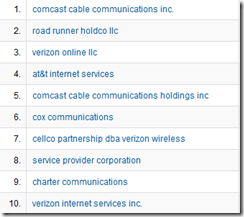
The Top 10 Service Providers are ISPs as expected.

image

What gets more interesting is the companies who are listed as Service Providers.  Note: it can be difficult sometimes to separate a Telecom company visiting vs. an ISP so I am not including Telecoms in the following list of companies.  Here is a sample from a scan of who is reading GreenM3 from their work locations.

  • Microsoft
  • RIM
  • Cisco
  • HP
  • Emerson
  • Dell
  • APC
  • Intel
  • Extreme Networks
  • Apple
  • Opera Software
  • Amazon.com
  • IBM
  • Savvis
  • AMD
  • Hughes Network Systems
  • JP Morgan Chase
  • Seamicro
  • Boeing
  • Waggener Edstrom
  • Best Buy
  • Softbank
  • Oracle
  • Yahoo
  • Data Center Dynamics
  • EMC
  • Facebook
  • Morgan Stanley
  • Accenture