One way to look at Green Data Center Start-ups are they founded by engineers and scientists or VCs

Two of my cloud computing engineering friends and I are having a blast working on a technology solution that can be used in data centers as well as many other areas. I ran across Steve Blank's post on

How Scientists and Engineers Got It Right, and VC’s Got It Wrong

There are many parts of Steve's post that resonate with our team.

Startups are not smaller versions of large companies. Large companies execute known business models. In the real world a startup is about the search for a business model or more accurately, startups are a temporary organization designed to search for a scalable and repeatable business model.

...

Scientists and engineers as founders and startup CEOs is one of the least celebrated contributions of Silicon Valley.

It might be its most important.

We all worked in Silicon Valley, so we have a bunch of methods ingrained our thinking.

Why It’s “Silicon” Valley
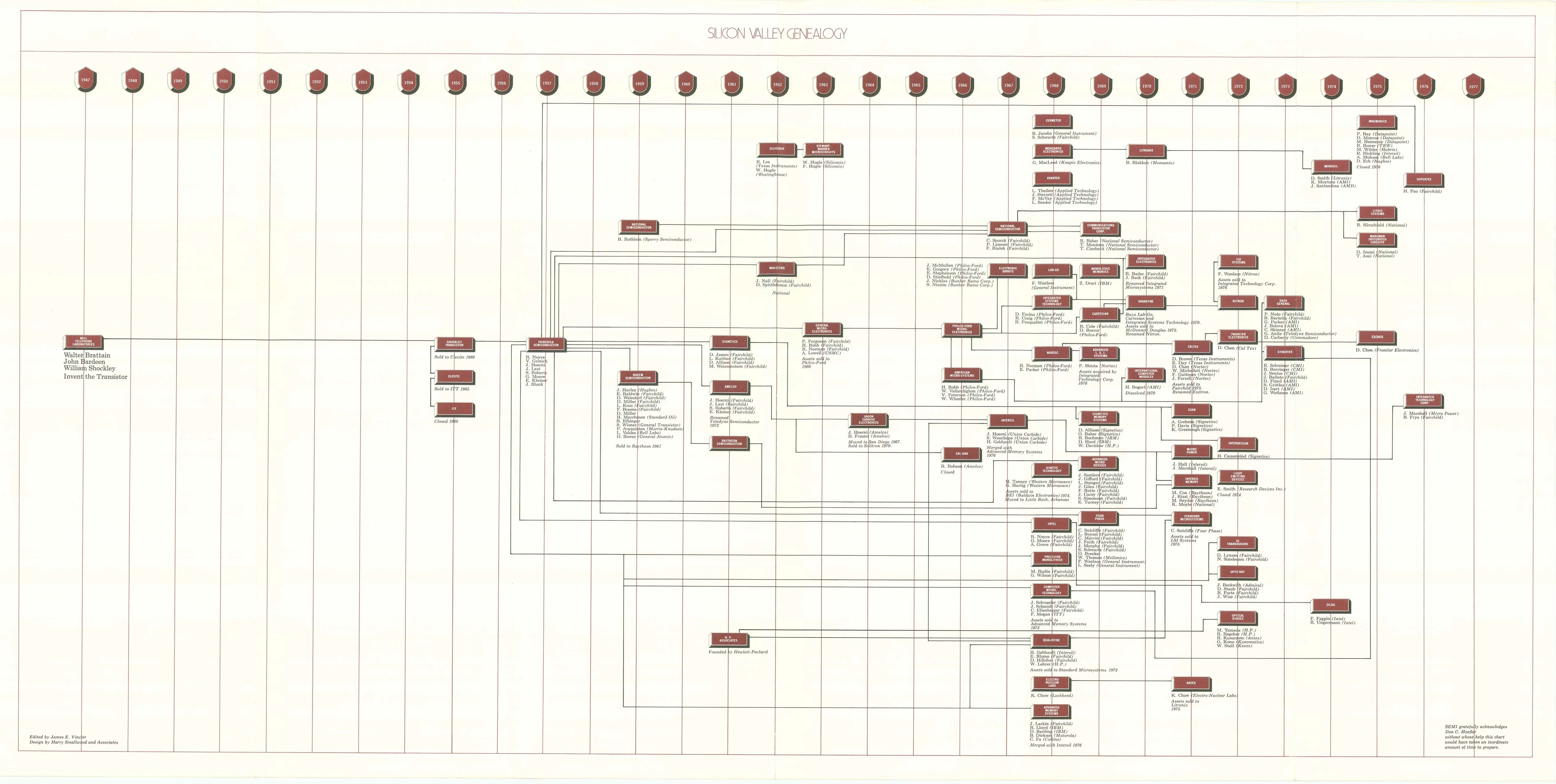
In 1956 entrepreneurship as we know it would change forever.  At the time it didn’t appear earthshaking or momentous. Shockley Semiconductor Laboratory, the first semiconductor company in the valley, set up shop in Mountain View. Fifteen months later eight of Shockley’s employees (three physicists, an electrical engineer, an industrial engineer, a mechanical engineer, a metallurgist and a physical chemist) founded Fairchild Semiconductor.  (Every chip company in Silicon Valley can trace their lineage from Fairchild.)

The history of Fairchild was one of applied experimentation. It wasn’t pure research, but rather a culture of taking sufficient risks to get to market. It was learning, discovery, iteration and execution.  The goal was commercial products, but as scientists and engineers the company’s founders realized that at times the cost of experimentationwas failure. And just as they don’t punish failure in a research lab, they didn’t fire scientists whose experiments didn’t work. Instead the company built a culture where when you hit a wall, you backed up and tried a different path. (In 21st century parlance we say that innovation in the early semiconductor business was all about “pivoting” while aiming for salable products.)

The Fairchild approach would shape Silicon Valley’s entrepreneurial ethos: In startups, failure was treated as experience (until you ran out of money.)

Conveniently, our idea does not need VC money or MBAs.

Scientists and Engineers = Innovation and Entrepreneurship
Yet when venture capital got involved they brought all the processes to administer existing companies they learned in business school – how to write a business plan, accounting, organizational behavior, managerial skills, marketing, operations, etc. This set up a conflict with the learning, discovery and experimentation style of the original valley founders.

Yet because of the Golden Rule, the VC’s got to set how startups were built and managed (those who have the gold set the rules.)

I have been reading Steve Blank and some of his ideas as he experiments with business models.

Earlier this year we developed a class in the Stanford Technology Ventures Program, (the entrepreneurship center at Stanford’s School of Engineering), to provide scientists and engineers just those tools – how to think about all the parts of building a business, not just the product. The Stanford class introduced the first management tools for entrepreneurs built around the business model / customer development / agile development solution stack. (You can read about the class here.)

Some of the best data center conversations I have are on new business models not technology. Give it a try sometime.  It is much more fun.
Server Secret is getting out, on-chip Networking is more efficient, Facebook publishes Tilera 3X performance per watt vs. Xeon

There is a bunch of news on Facebook publishing results on the Tilera Server.

Facebook study shows Tilera processors are four times more energy efficient

Facebook sides with Tilera in the server architecture debate

Facebook: Tilera chips more energy efficient than x86

What I found as most useful is the PDF of the paper that Facebook published.

Many-Core Key-Value Store
Mateusz Berezecki
Facebook
mateuszb@fb.com
Eitan Frachtenberg
Facebook
etc@fb.com
Mike Paleczny
Facebook
mpal@fb.com
Kenneth Steele
Tilera
ken@tilera.com

We show that the throughput, response time, and power
consumption of a high-core-count processor operating at a low
clock rate and very low power consumption can perform well
when compared to a platform using faster but fewer commodity
cores. Specific measurements are made for a key-value store,
Memcached, using a variety of systems based on three different
processors: the 4-core Intel Xeon L5520, 8-core AMD Opteron
6128 HE, and 64-core Tilera TILEPro64.

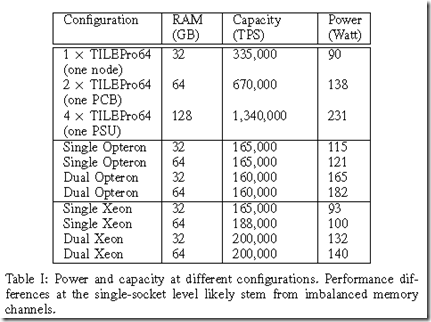
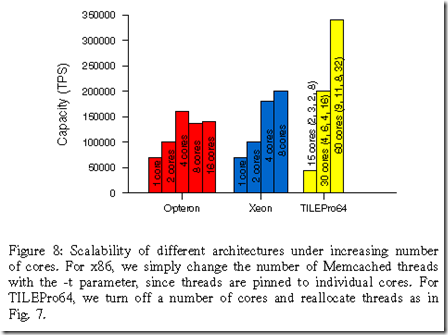
Here is the comparison of the Tilera, AMD, and Intel.

image

image

Here is a good tip and reason to think about more than 64 GB of RAM per server for memcache services.

As a comparison basis, we could populate the x86-based
servers with many more DIMMs (up to a theoretical 384GB
in the Opteron’s case, or twice that if using 16GB DIMMs).
But there are two operational limitations that render this
choice impractical. First, the throughput requirement of the
server grows with the amount of data and can easily exceed
the processor or network interface capacity in a single
commodity server. Second, placing this much data in a single
server is risky: all servers fail eventually, and rebuilding the
KV store for so much data, key by key, is prohibitively
slow. So in practice, we rarely place much more than 64GB
of table data in a single failure domain. (In the S2Q case,
CPUs, RAM, BMC, and NICs are independent at the 32GB
level; motherboard are independent and hot-swappable at the
64GB level; and only the PSU is shared among 128GB worth
of data.)

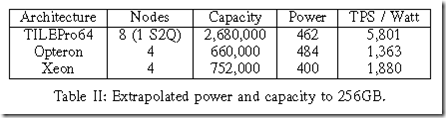
But, if you want to go beyond 64 GB, here are some numbers for a 256 GB RAM configuration.

image

And Conclusions.

Our experiments show that a tuned version of
Memcached on the 64-core Tilera TILEPro64 can yield at
least 67% higher throughput than low-power x86 servers at
comparable latency. When taking power and node integration
into account as well, a TILEPro64-based S2Q server
with 8 processors handles at least three times as many
transactions per second per Watt as the x86-based servers
with the same memory footprint.

With the server secret of on-chip networking discussed.

The main reasons for this performance are the elimination
or parallelization of serializing bottlenecks using the on-chip
network; and the allocation of different cores to different
functions such as kernel networking stack and application
modules. This technique can be very useful across architectures,
particularly as the number of cores increases. In
our study, the TILEPro64 exhibits near-linear throughput
scaling with the number of cores, up to 48 UDP cores.

Funny Story, how I got my Job at Apple Computer from HP

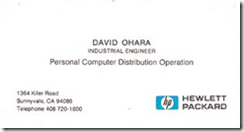
Back in 1990-1992 I was an Industrial Engineer at HP's Personal Computer Distribution Operation (PCDO), working on distribution logistics, packaging engineering, and a bunch of other technologies like Bar Codes and material handling equipment.

image

Around October 1991, I interviewed at Apple for a distribution engineering job at Apple.  In my final interview at Apple, Barry Vorpahl the hiring manager said "we really like your background for the job, but you don't seem like you are really interested in the job."  I told Barry, "well, I am in the middle of a project right now, and I don't want to leave until I finish."  Barry replied, "That's OK.  How long until your project is done?"  I casually responded, "6 months."  Barry, gasps, "6 months, we can't wait that long."

I had a pleasant closing interview with Cheryl Erickson who worked in Apple HR.

Around, Mar 1992,  I got a call from Apple and asked if I was interested in the job at Apple.  What job?  The job I interview for 6 months ago.  They hadn't found a fit, and were impressed that I wanted to stick with my project until the end. One month later, I started working at Apple.

I didn't know a lot about interviewing back then, but I would have never thought that the first step in getting a job at Apple was saying I was too busy.

I am writing this up as some friends of mine are being recruited, and I am telling them it is OK to say you are too busy if you are.

Stress Testing the Kitchen, 12 pizzas cooked for Construction Party

I've been practicing with my pizza oven and have cooked quite a few pizzas for data center friends with four pizzas cooked at the most.  Last night we had a party for our construction party.

image

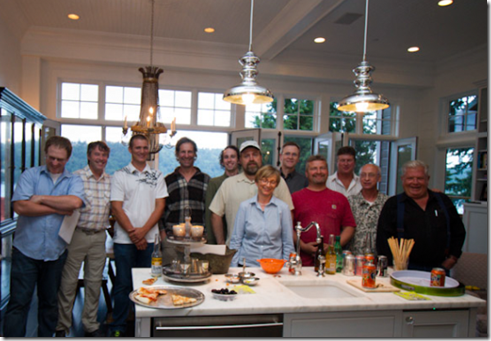
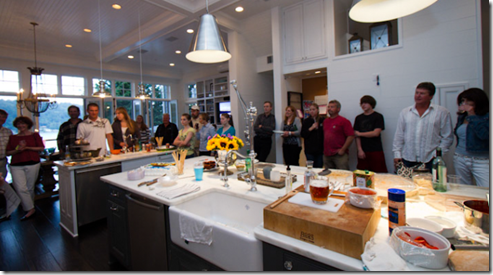
With all these people, 1/2 of the people there are in the picture below.  We needed to cook more than 4 pizzas.  12 is what we cooked, but I had enough dough for 15.

image

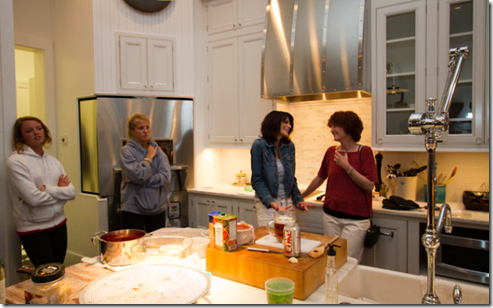
Here is a view of the kitchen after finished cooking the dozen pizzas.

image

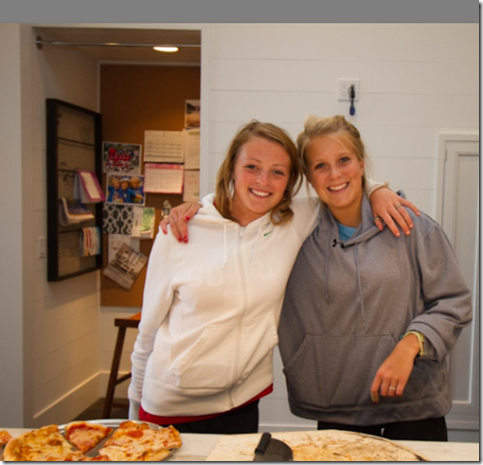
Luckily I had help cooking the dozen pizzas.  I can cook a pizza in 6 minutes, rotating the pizza after 3 minutes, then load another pizza, cooking 2 pizzas at the same time.  I needed some help preparing, cutting, and serving the pizzas while I focused on cooking.  Margaret and Maddy were our hired help, and are part of the kids swim group.

image

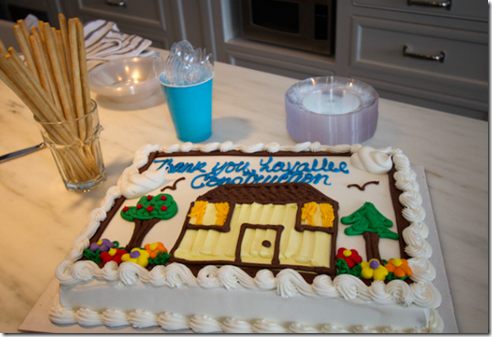
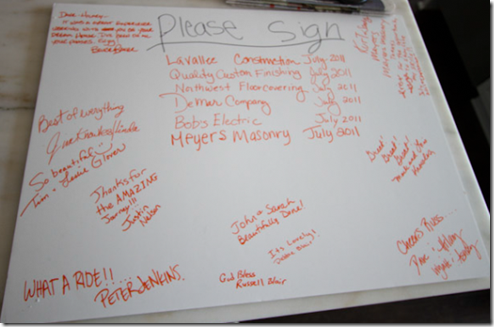
Our construction company was Lavallee Construction, http://www.lavalleeconstruction.net/.

image

image

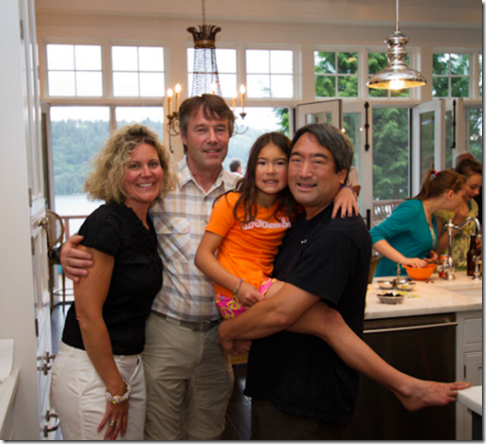
Here is Russ Lavallee with the family.

image

except for my son who was socializing his new look.

image

Now that  I cooked 12 pizzas, I'll see if I can cook 20 pizzas.  In theory I could cook the 20 pizzas in an hour, but find about 10 an hour a good enough pace.  I never thought I would say I feel comfortable cooking 10 pizzas an hour at home.  Tonight is an easy night, I just have three pizza doughs for cooking.