California environmentalist sue to block Solar Farm, $1.8 billion 399MW project

It's kind of hard to get renewable energy, especially when various groups block projects based on the environmental impact.  It is really hard tto have zero environmental impact.  An example of the problem is in the SJ Mercury news article about a solar project facing a court battle.

Huge San Benito County solar farm proposal has its day in court

By Paul Rogers

progers@mercurynews.com

Developer PV2 Energy of San Francisco is proposing to build a 399-megawatt solar farm over 3,200...

A proposal to build one of the world's largest solar farms south of Silicon Valley had its day in court Monday as a long-simmering battle between the Bay Area investors supporting the project and environmentalists who say it will harm wildlife finally came before a judge.

At the center of the debate is a $1.8 billion, 399-megawatt solar farm proposed for Panoche Valley, an arid expanse of rangeland and barbed wire 50 miles southeast of Hollister. Last year, the San Benito County Board of Supervisors voted to approve the project, saying it would make rustic San Benito County -- known more for its cattle and condors than computer chips -- a national center of clean energy.

What is the problem?  The environmentalist think this is the wrong place to put solar farm.

Society, the Sierra Club and a group of local residents known as Save Panoche Valley sued to block it, claiming the 4 million solar panels that would be constructed across the roughly 3,200 acres west of Interstate-5 would harm endangered species and disrupt the rural character of the area.

"Solar obviously is very critical. No one disputes the necessity for solar energy," said Rose Zoia of Santa Rosa, the attorney representing the three environmental groups, during oral arguments. "The issue here is that it is improper on this site."

This problem is occurring at other California projects.

The case is symbolic of a recent trend across California and other parts of the nation. As concerns over global warming have grown and with it, government and private funding for huge solar and wind projects, the main opponents have often been environmental groups. The issue has split the environmental movement. Some conservationists argue that they need to change their approach while others stick to the lawsuits they have traditionally used to block logging, mining and development.

Last month, for example, California Gov. Jerry Brown filed a brief asking a federal court to deny a request by an environmental group seeking an injunction to stop a $2.2 billion solar power project in the Mojave Desert. The Western Watersheds Project wants to stop construction of the 370-megawatt Ivanpah project because of desert tortoises at the site.

Three Tips for a Smarter City project, IBM's Justin Cook shares insights working on Portland modeling project

I got a chance to talk to IBM's Justin Cook, Program Director, System Dynamics for Smarter Cities about IBM's press release for the Smarter Cities Portland project. 

IBM and City of Portland Collaborate to Build a Smarter City

Portland, Oregon, USA - 09 Aug 2011: To better understand the dynamic behavior of cities, the City of Portland and IBM (NYSE: IBM) have collaborated to develop an interactive model of the relationships that exist among the city's core systems, including the economy, housing, education, public safety, transportation, healthcare/wellness, government services and utilities. The resulting computer simulation allowed Portland's leaders to see how city systems work together, and in turn identify opportunities to become a smarter city. The model was built to support the development of metrics for the Portland Plan, the City's roadmap for the next 25 years.

I've got friends in Portland, so I appreciate the unique environment Portland has.  Here is what IBM discusses as when and why Portland was chose for the Smarter City project.

IBM approached the City of Portland in late 2009, attracted by the City's reputation for pioneering efforts in long-range urban planning. To kick off the project, in April of 2010 IBM facilitated sessions with over 75 Portland-area subject matter experts in a wide variety of fields to learn about system interconnection points in Portland. Later, with help from researchers at Portland State University and systems software company Forio Business Simulations, the City and IBM collected approximately 10 years of historical data from across the city to support the model. The year-long project resulted in a computer model of Portland as an interconnected system that provides planners at the Portland Bureau of Planning and Sustainability with an interactive visual model that allows them to navigate and test changes in the City's systems.

In talking to Justin, I asked him what Tips he had for implementing this complex project.  Here are three tips Justin shared with me.

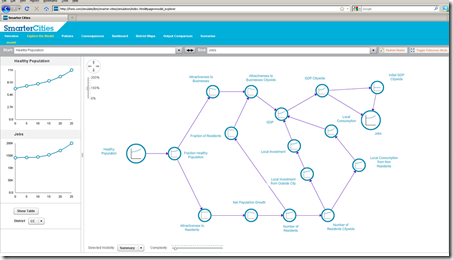
  1. Discuss the relationships of the groups to understand their perspectives and views.  This data will help you understand the semantics of information that helps you build a model.   There were 75 subject matter experts and multiple organizations involved in discussing initiatives for Portland's Plan.  Below is a view of one dashboard showing various metrics that get you thinking beyond an individual department's view.image
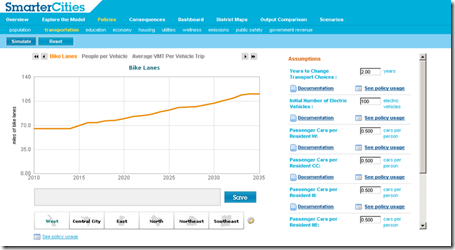
  2. Assumptions are openly documented to let others know inputs into the models.  Below is an example of bike lanes.image
  3. Trade-off between transparency and complexity where a simpler approach is easier to understand, therefore appears more transparent.  Justin shared that IBM's system dynamics team had 7,000 questions identified in a smarter city modeling project.

IBM is working with other cities to apply the lessons learned in Portland.

This collaboration with the City of Portland has also proven valuable for IBM.  IBM is applying its experience and modeling capabilities developed in this collaboration with the City of Portland to create offerings that will help other cities leverage systems dynamics modeling capabilities to enhance their city strategic planning efforts. Based upon IBM's experience in working with and conducting assessments of cities around the world, they've found that strategic planning in many cities is still being done in stovepipes without a holistic view of impacts/consequences across systems. By leveraging systems dynamics modeling techniques, IBM will be able to help other cities plan "smarter".

In closing Justin and I discussed the potential for projects that affect multiple city metrics and multiple city organizations to see in the model how ideas like more walking & biking lanes can address obesity, getting people out of cars which then reduces the carbon footprint of the city.  Bet you didn't think that addressing obesity could fit in a carbon reduction strategy.  IBM and Portland see the relationships in this and many other areas.

How valuable is the IBM Smarter City model?  We'll see some of the first results from Portland.

ABRY Partners and Berkshire Partners acquire Telx from GI Partners

Last week a friend asked who was acquiring Telx.  I told him I didn't know but, I found the tweet on Telx being acquired and posted the question.

Who is acquiring Telx?

WEDNESDAY, AUGUST 3, 2011 AT 8:44AM

Found this Tweet.

image

Well, here is the press release with the answer.

The Telx Group Acquired by ABRY Partners and Berkshire Partners

GI Partners Sells Leading Colocation and Interconnection Company to Two Boston-Based Investment Firms
August 8, 2011 9:30 AM EDT

MENLO PARK, CA and BOSTON, MA -- (MARKET WIRE) -- 08/08/11 -- GI Partners ("GI"), a leading mid-market private investment firm, announced today the sale of its portfolio company, The Telx Group, Inc. ("Telx"), one of the fastest growing providers of global interconnection and colocation facilities, to ABRY Partners and Berkshire Partners LLC, two Boston-based investment firms. Terms of the transaction were not disclosed.

Telx facilities serve over 900 customers with approximately 34,000 interconnections, and customers can connect with hundreds of communication service providers, enterprises and cloud providers in Telx facilities. The company was acquired by GI Partners in 2006 and, under the investment firm's nearly five-year stewardship, Telx achieved considerable organic growth in its existing markets and also dramatically improved its competitive position as a result of key add-on acquisitions. The company has since developed a national footprint of 15 locations starting from two facilities at the time of acquisition. GI Partners also significantly expanded the management team with the appointment of industry veteran Eric Shepcaro as CEO, in addition to several other senior positions. As a result of these and other initiatives, Telx achieved dramatic sales and EBITDA gains, including topline growth of over 40% throughout the hold period despite the recession, landing on the Inc. 5000 list two consecutive years in a row and earning a nod from Red Herring as a Top 100 North American Company.

Wall to remember a bad 1st experiment, Japanese American Internment logistics, shipping 276 to prison

Both of my parents were in Internment Camps during WWII, along with many of my Aunts and Uncles when they were all children.

"Most of the 110,000 persons removed for reasons of 'national security' were school-age children, infants and young adults not yet of voting age."
- "Years of Infamy", Michi Weglyn

...

These Japanese Americans, half of whom were children, were incarcerated for up to 4 years, without due process of law or any factual basis, in bleak, remote camps surrounded by barbed wire and armed guards.

...

Rather, the causes for this unprecedented action in American history, according to the Commission on Wartime Relocation and Internment of Civilians, "were motivated largely by racial prejudice, wartime hysteria, and a failure of political leadership."

On Aug 6, 2011 The NYTimes writes about a new Wall was dedicated on Bainbridge Island.

A Wall to Remember an Era’s First Exiles

Matthew Ryan Williams for The New York Times

Holly Wilson visited a newly completed memorial on Bainbridge Island, a cedar and stone wall dedicated to its residents' World War II experience. More Photos »

By KATHARINE Q. SEELYE
Published: August 5, 2011

BAINBRIDGE ISLAND, Wash. — Frank Kitamoto was only 2 when he and his family — and more than 270 others of Japanese ancestry — were forcibly removed from this forested island and sent to an internment camp after Japan bombed Pearl Harbor in World War II. Mr. Kitamoto, now 72, said he spent many of his younger years in a severe identity crisis, ashamed of his Japanese heritage and wishing he were white. Other young men went so far as to have plastic surgery to disguise their Japanese features. Some committed suicide.

Bainbridge Island was the 1st experiment to figure out the logistics of shipping hundreds of people, 2/3 US citizens to prison for having Japanese ancestry as a crime.

Associated Press

Japanese-American residents of Bainbridge Island, Washington, boarded a ferry to Seattle. From there, they were transferred to a camp in California. The government chose Bainbridge Island as its test run for mass evacuations. More Photos »

“As a kid, I thought this was the land of equality and freedom, and so this couldn’t be happening because of discrimination,” Mr. Kitamoto, who became a dentist, said the other day in his office, where one wall is covered with photos from that era. “So I thought it was because there was something wrong with me, that I was a bad person.”

One of the most famous photographs from this experiment is a mother with her 13 month old daughter taken by the SeattleTimes.

Everywhere she went, Kayo Natalie Hayashida Ong, now 70, was greeted over and again with delight and recognition as "the baby!"

An iconic photograph of her at age 1, asleep in her mother's arms as her family was forcibly removed from their Bainbridge Island home during World War II, became one of the best-known symbols of a dark period in American history.

MUSEUM OF HISTORY AND INDUSTRY /

Fumiko Hayashida, then 31, carries her daughter Natalie, 1, to the Bainbridge ferry and exile.

If my daughter had been born 70 years ago, she would be amongst the other 1 year olds who were a threat to US security.

At the time, Executive Order 9066 was justified as a "military necessity" to protect against domestic espionage and sabotage. However, it was later documented that "our government had in its possession proof that not one Japanese American, citizen or not, had engaged in espionage, not one had committed any act of sabotage." (Michi Weglyn, 1976).

There was one loan voice in the USA who spoke through the media, a Bainbridge publication.

_TIM4636 - Milly and Walt Woodward at the Review -1945

Two months before Pearl Harbor, Walt and Milly Woodward pledged in a front page editorial to "always strive to speak the truth, unafraid, whether it be on a national issue or something purely local." In 1940, the young couple–barely thirty–had purchased the weekly Bainbridge Review, a chatty conveyor of neighborhood gossip. A year later, when the U.S. entered WWII, the couple had transformed the Review into a respected community paper full of current, factual news, and an editorial page that drew national attention.
The day after Pearl Harbor, Milly and Walt Woodward warned, "There is the danger of a blind, wild hysterical hatred of all persons who can trace ancestry to Japan. That some of those persons happen to be American citizens...easily could be swept aside by mob hysteria." Urging Islanders to remain calm, the Woodwards continued, " The Review says this: These Japanese Americans of ours haven't bombed anybody...They have given every indication of loyalty to this nation. They have sent...their own sons–six of them–into the United States Army."
The Woodwards continued, throughout the war, to speak against the constitutional violations inherent in E.O. 9066. The tiny Bainbridge Review has been singled out nationally as the lone newspaper to take such a stand. Also, in an attempt to report accurately on Islanders' lives, Milly and Walt Woodward hired high school students to report from Manzanar and, later, Minidoka on the daily events in the exiles' lives. Thus Islanders could keep track of each other. Perhaps as a result of that, 150 of the 272 exiled Islanders returned to Bainbridge, a greater percentage than most communities.

I don't think my children could understand why grandma and grandpa were in prison.  Which is why the Bainbridge wall is dedicated with these words.

Nidoto Nai Yoni, translated as

"Let It Not Happen Again"

is the motto and mission of the Nikkei Exclusion Memorial.

_TIM3977 - Evacuation Day: Walking onto the Ferry Kelohken

Fiercely Independent Guy/Gadfly, Innovator's DNA, and Chaos Monkey

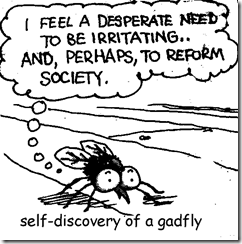
I was telling one of my good friends who will tell me when I am wrong the story about how one of my other good friends described me as a Fiercely Independent Guy.  She says, "remember, I am the one who said you are a gadfly.  So, you can still be use the FIG acronym - Fiercely Independent Gadfly, instead of Fiercely Independent Guy.  Now it was one thing to describe myself as the Fiercely Independent Guy, it is another to say I am Fiercely Independent Gadfly.

What is a Gadfly?  Merriam's definition.

Definition of GADFLY

1 : any of various flies (as a horsefly, botfly, or warble fly) that bite or annoy livestock

2 : a person who stimulates or annoys especially by persistent criticism

It can hurt to be called a Gadfly.
image

These two people who categorized me as a gadfly could not be more different - one a Prince of the institutional church, almost 70 years old; the other a model for the Jesus follower of the future, recognized by many for his genius with people that the church routinely does not welcome.  What they have in common is (a) they are 2 of the most powerful men in churchianity I know personally and (b) they took the time and effort to call me a gadfly.  When both of them said this term, in very different settings,  it was meant as a slur, a term of disparagement - and trust me, it hurt.

...

There is a funny thing about this slur - inside many institutions, it is a term to shut down new ideas, criticism or even challenges to power or sacred cow.   Outside some of the most fallow institutions, these very characteristics are not a negative category or a way to stifle new life - they are, in fact, the core ethos the organizations strives to achieve.  As is so often the case, a word meant to demean is actually a word of holiness, redeemed as part of our essence as beloved creatures made in God's image.

Do you know who is one of the most famous Gadfly is?  Socrates.

The term "gadfly" (Ancient Greek: μυω̃ψ, myops)[1] was used by Plato in the Apology[2] to describe Socrates' relationship of uncomfortable goad to the Athenian political scene, which he compared to a slow and dimwitted horse. During his defense when on trial for his life, Socrates, according to Plato's writings, pointed out that dissent, like the gadfly, was easy to swat, but the cost to society of silencing individuals who were irritating could be very high. "If you kill a man like me, you will injure yourselves more than you will injure me," because his role was that of a gadfly, "to sting people and whip them into a fury, all in the service of truth." This may have been one of the earliest descriptions of pragmatic ethics.

The nice thing is with 30 years in the industry I've developed more patience and you can achieve results without being overzealous.

The Innovator's DNA is an example of a more tactful way to be a gadfly.

  • Associating—drawing connections between questions, problems, or ideas from unrelated fields
  • Questioning—posing queries that challenge common wisdom
  • Observing—scrutinizing the behavior of customers, suppliers, and competitors to identify new ways of doing things
  • Networking—meeting people with different ideas and perspectives
  • Experimenting—constructing interactive experiences and provoking unorthodox responses to see what insights emerge

When engaged in consistently, these actions—questioning, observing,networking, and experimenting—triggered associational thinking to deliver new businesses, products, services, and/or processes. Most of us think creativity is an entirely cognitive skill; it all happens in the brain. A critical insight from our research is that one’s ability to generate innovative ideas is not merely a function of the mind, but also a function of behaviors. This is good news for us all because it means that if we change our behaviors, we can improve our creative impact. By completing an Innovator’s DNA assessment, you can better understand your personal innovation skill strengths and learn how to make them even better.

Was Socrates an Innovator, labeled as a Gadfly with critics hoping he would go away?

Socrates was in all things an innovator, in religion, in as much as he sought to eliminate from the theology of his contemporaries “those lies which poets tell “; in politics, in as much as he distrusted several institutions dear to Athenian democracy; in education, in as much as he waged war against authority, and in a certain sense made each man the measure of his own actions.

It is because Socrates was an innovator that we, who see in him the founder of philosophical inquiry, regard him as a great man; it was because Socrates was an innovator that old -fashioned Athenians, who saw’ in the new fangled culture the origin of all their recent distresses and disasters, regarded him as a great criminal.

The Gadfly label is applied as Socrates was a gadfly to a horse.

The term "gadfly" (Ancient Greek: μυω̃ψ, myops)[1] was used by Plato in the Apology[2] to describe Socrates' relationship of uncomfortable goad to the Athenian political scene, which he compared to a slow and dimwitted horse.

Isn't this the same as Mike Manos's talk on Chaos Monkeys, Donkeys and Innovation of Action?

In my talk I tried to focus on what I felt to be emerging camps at the conference.    To the first, I placed a slide prominently featuring Eeyore (from Winnie the Pooh fame) and captured many of the quotes I had heard at the conference referring to how the Cloud, and new technologies were something to be mistrusted rather than an opportunity to help drive the conversation.     I then stated that we as an industry were an industry of donkeys.  That fact seems to be backed up by data.   I have to admit, I was a bit nervous calling a room full of perhaps the most dedicated professionals in our industry a bunch of donkeys – but I always call it like I see it.

I contrasted this with those willing to evolve their thought forward, embrace that Innovation of Action by highlighting the Cloud example of Netflix.   When Netflix moved heavily into the cloud they clearly wanted to evolve past the normal IT environment and build real resiliency into their product.   They did so by creating a rogue process (on purpose) call the Chaos Monkey which randomly shut down processes and wreaked havoc in their environment.   At first the Chaos Monkey was painful, but as they architected around those impacts their environments got stronger.   This was no ordinary IT environment.  This was something similar, but new.  The Chaos Monkey creates Action, results in Action and on the whole moves the ball forward.

Interestingly after my talk I literally have dozens of people come up and admit they had been donkeys and offered to reconnect next year to demonstrate what they had done to evolve their operations.

So, if you are called a Gadfly, maybe the person is a Horse or a Donkey, and you are a Chaos Monkey, an Innovator.

" Criticism may not be agreeable, but it is necessary. 
It fulfills the same function as pain in the human body. It calls attention to an unhealthy state of things."
- Winston Churchill

"A society that gets rid of all its troublemakers goes downhill."
Robert A. Heinlein