Off to GigaOm Structure

Last year I attended GigaOm Structure for the first time as a blogger.  This year I am attending as a GigaOm Analyst.  

NewImage

The following are some of the sponsors there that are interesting to the data center user.

NewImageNewImageNewImageNewImage

NewImage

I'll be bouncing from data center discussions to Cloud and Big Data.  Looking forward to a great event to network and stimulate new ideas.

Two different styles of reporting on news; BBC (traditional) vs. GigaOm (Web2.0)

There are a bunch of news on Google's reporting of on governments that request Google to remove content from their website.

Google reports 'alarming' rise in government censorship requests

CNN - ‎2 hours ago‎
(CNN) -- Western governments, including the United States, appear to be stepping up efforts to censor Internet search results and YouTube videos, according to a "transparency report" released by Google. "It's alarming not only because free expression ...
 

Google Transparency Report reveals take-down requests from governments

Siliconrepublic.com - ‎5 hours ago‎
The fifth update to Google's Transparency Report reveals an increase in informal requests from governments to remove political speech from their services. Google's Transparency Report first saw the light of day about two years ago.
 

Google Transparency Report: U.S. Content Removal Requests Increased 103%

TechCrunch - ‎1 hour ago‎
To put this into perspective: in the first half of 2011, Google was only asked to remove 757 items in the US and only received 92 removal requests. Google complied with 42% of these requests. According to its reportGoogle received 6321 user data ...
 

Google Transparency Report reveals 'alarming' rise in government censorship ...

GlobalPost - ‎5 hours ago‎
Google has seen an increase in requests from governments to take down internet content they don't like, according to its latest Transparency ReportGoogle has reported a rise in the number of requests it received from governments to censor its search ...

One of the interesting things I find is how a traditional news organization will report vs. a Web2.0.  

The BBC has their article here.

Google reveals 'terrorism video' removals

This article doesn't say who the author is or provide any links to the original content.  Trust us we are the BBC.  We know the facts.

GigaOm has a post its post here.

Google says US government takedown requests have doubled in last six months

New data released by Google shows that US government requests to remove search results, YouTube videos and other content has increased by 103 percent in the last half year. The company also released takedown information from around the world that show countries targeting everything from social network profiles to a citizen peeing on a passport.


This post has the name of the author, multiple links, stats on sharing through Twitter, Facebook, etc.

The original Google post is here.

More transparency into government requests

June 17, 2012 at 8:23 PM
About two years ago, we launched our interactive Transparency Report. We startedby disclosing data about government requests. Since then, we’ve been steadilyadding new features, like graphs showing traffic patterns and disruptions to Google services from different countries. And just a couple weeks ago, we launched a new section showing the requests we get from copyright holders to remove search results.

The traditional way is trust us our brand, our publication.  The Web2.0 is show us where you get your information from and who you are.

Which do you trust more to read?  BBC or GigaOm.  How about your kids or nephews/nieces?

(Disclosure: I work for GigaOm Pro as an analyst.)

Google's Story of Google Apps, 65-85% less energy, US GSA migrates 17,000 for a $285,000 savings (90% energy reduction)

Google had a viral video on The Story of Send.  Google just released a post that fits in the same theme with what could be "The Story of Google Apps."

NewImage

The blog post is backed up with a paper.

The data that gives this story credibility is the win Google had for Google Apps with the US GSA.

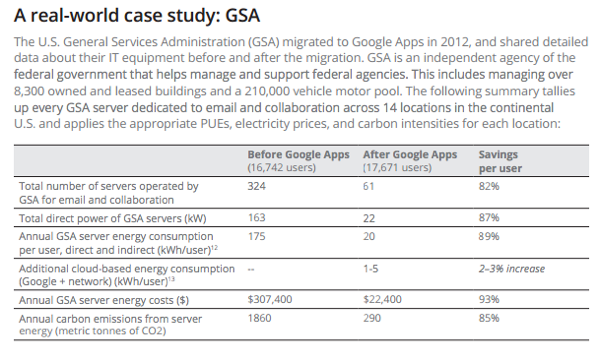
Lower energy use results in less carbon pollution and more energy saved for organizations. That’s what happened at the U.S. General Services Administration (GSA), which recently switched its 17,000 users to Google Apps for Government. We found that the GSA was able to reduce server energy consumption by nearly 90% and carbon emissions by 85%. That means the GSA will save an estimated $285,000 annually on energy costs alone, a 93% cost reduction.

The specifics of the GSA story are here.

NewImage

It wasn't too long ago that any small business that wanted e-mail was seriously looking at putting an e-mail server on site.  What small business does that now?  Along with that came Office licenses.  Google is targeting this whole Office document e-mail system with cloud services that are much more efficient.

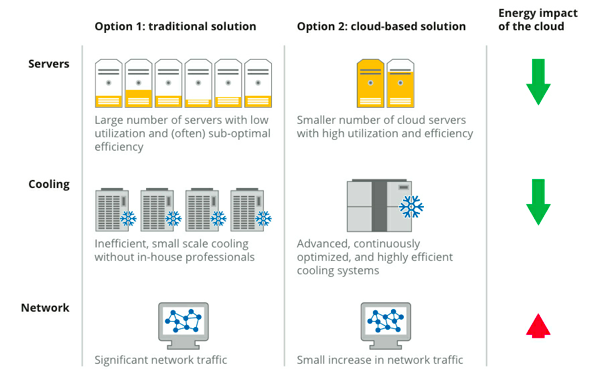
A typical organization has a lot more servers than it needs—for backup, failures and spikes in demand for computing. Cloud-based service providers like Google aggregate demand across thousands of people, substantially increasing how much servers are utilized. And our data centers use equipment and software specially designed to minimize energy use. The cloud can do the same work much more efficiently than locally hosted servers.

All of this is built on Google's green data centers.

We’ve built efficient data centers all over the world, even designing them in ways that make the best use of the natural environment, and we continue working to improve their performance. We think using the super-efficient cloud to deliver services like Google Apps can be part of the solution towards a more energy efficient future.

Posted by Urs Hoelzle, Senior Vice President for Technical Infrastructure


(Cross-posted on the Google Green Blog)

MacBook Pro or MacBook Air; Are you a Creator or Consumer?

Forbes has an article with a write who looked at the MacBook Pro Retina and chose the Macbook Air.

What is disappointed with articles like this is the author doesn't take the time to explain their needs, and why the MacBook Air was right for them then the MacBook Pro.

One of the simple questions to ask is whether you are Creator of content or a Consumer?  The growth of the iPad is due to how much people are consumers of content.  Any one who uses the iPad as their authoring tool slows their productivity.

The writer of the Forbes article is a Tech Journalist which would put him in the category of creator, but also a creator that pretty much sticks I would guess to words.  Why?

In his article he says his choice is a MacBook Air with 128GB of memory.

I got the low-end model with 4 GB of RAM and 128 GB of storage because that suited me well enough on the 11-inch I had, especially now that I can store data in the cloud.

As soon as you take lots of photos, let alone add videos, the 256GB of storage is a challenge.  Loading photo imaging and video imaging apps will also push the 4GB RAM limit.

Almost everyone talks about the Retina display.  What I am looking at is what Mac do I get for a wide range of researching topics (lots of windows open), image and video editing.  Getting used to the MacBook Air where the SSD drive was done well, getting 512 GB of storage is a priority.  Getting 8GB of memory makes sense with the 512 GB of SSD.

A Macbook Air has a 4GB limit.  the 512 GB SSD is an expensive option that gets you quickly up to the price of the MacBook Pro.

For me, I decided to get a MacBook Pro with 16GB of RAM, 512 GB SSD, and Retina display.  I spend time bouncing between MarsEdit, Word, Excel, PowerPoint, Aperture, Final Cut Pro.  I travel, but I don't spend a lot of time on my laptop while travelling, rarely using my computer while on a flight. 

Few of you do what I do, so buying MacBook Pro Retina based on my buying one doesn't make sense.  

Why should you buy a MacBook Pro or MacBook Air because another writer says it is right for them?  How many of you are journalists?
Why I ordered a MacBook Pro - More RAM, SSD, and Pixels

I love my MacBook Air that I bought as part of a switch from Windows.

The MacBook Pro is announced and I wasn't interested at first, but after thinking for a bit, I could use three things.  More RAM, More SSD space, and More pixels.

NewImage

There is plenty of news like how the MacBook Pro is aimed at the heart. Really? You think this is the issue?

The new MacBook Pro with Retina Display is not a particularly practical unit. It appeals to your heart, not your head. I will grant the argument that it is practical for a very small set of media professionals. The $2,199 low-end model, though, only comes with a non-upgradable 256 GB SSD drive. A media pro can blast through that piddling amount of storage space in no time at all.

With a heavy heart, I have decided not to the buy the gorgeous new MacBook Pro with Retina Display. I lust after the idea of 2,880 by 1,800 pixels gloriously showing off my awesome photos of the Grand Tetons, Half Dome and small children running from the cold droplets of a sprinkler system under a hot summer sun.

The MacBook Pro is getting bad reviews as hard to service.

Apple's new Retina display MacBook Pro has been taken apart and examined from the inside, revealing that the RAM is soldered onto the logic board and cannot be upgraded, and that the proprietary solid-state drive memory was supplied by Samsung.

The details come from iFixit's extensive teardown of the next-generation MacBook Pro, which the site published on Wednesday, just two days after the new notebook was announced. The solutions provider took particular issue with the design of the new MacBook Pro with respect to repairability, giving it a lowest possible score of 1 out of 10.

Why did I order a MacBook Pro after all this news?  

Versus my MacBook Air.  More than 4GB of RAM would be really nice.  The 4GB is getting painful.  256GB of SSD is just too constraining.  Everybody talks about the display with more pixels, but that is less of an urgent need.   My eyes aren't screaming for more pixels.  Seeing the world a bit fuzzy is OK for abstract thinking.

So, I took the leap and placed an order for 16GB of RAM with 512 SSD.  This is a significant upgrade from the MacBook Air I have.  The Air is fine, but I need more RAM and SSD space.  I don't live all in the cloud.  Do you?