Top 5 Modular Data Center Construction Companies

I have a post on the Top 5 Data Center Construction companies.  This post is a list of the Top 5 Modular Data Center Construction companies.  This list is based on conversations at conferences, bars, e-mail and phone calls and what companies come up.  If you don't already have these companies on your RFI list, you may now.

1. Dell Modula Data Center

The Smart Alternative to a Brick-and-Mortar Data Center: Dell MDC

Intelligent Connectivity and Flexibility: The Dell Modular Data Center
Take a look at the hyperefficient, snap-together, flexible choice over the traditional brick-and-mortar or pod-type data center: the Dell Modular Data Center (MDC) solution. Many key benefits make the Dell MDC a compelling alternative for your data center solution. Read a few of those benefits:
  • Speed: The Dell MDC can be designed, built, and up and running 75 percent faster than a traditional data center.
  • Efficient: Designed for hyperefficiency, the Dell MDC choice provides important advantages for flexible growth and cost reduction. When you choose an MDC from Dell, the Dell Data Center Solutions (DCS) engineering team works hard to optimize your entire data center to reduce operational costs. Best of all, the MDC is modular, so you can add only the modules you need, incrementally, as you grow, without substantial up-front costs.
  • Flexible: Where the competition force fits IT into a rigid shipping container, we collaborate with customers like you to custom build your MDC.

2. HP POD (Performance Optimized Datacenters)

HP Data Center Solutions

HP Performance Optimized Data Centers (HP PODs) are a portfolio of breakthrough, modular data centers that help enterprises rapidly and efficiently expand data center capacity and meet increasing service level agreements. Compared to traditional brick-and-mortar data centers, HP PODs help you scale capacity on demand, reduce capital expenditures and increase energy efficiency.

Along with our complete portfolio of HP POD solutions, HP provides turnkey solutions that help customers deliver on their data center strategies saving time and maximizing performance.

3. Compass Data Centers

NewImage

Your mission critical applications are too important to be housed in the same data center with other customers in a data center located hundreds of miles from your operations team. A Compass dedicated data center is built for you alone to control your operational costs, enhance security, and simplify your day to day operations like moves, adds and changes; and it can be delivered within six (6) months of pad ready site. The benefits of a having a dedicated facility would be worthless if it wasn’t located where you needed it, and that’s why Compass will build your new data center exactly where you want it.

4. AST Modular 

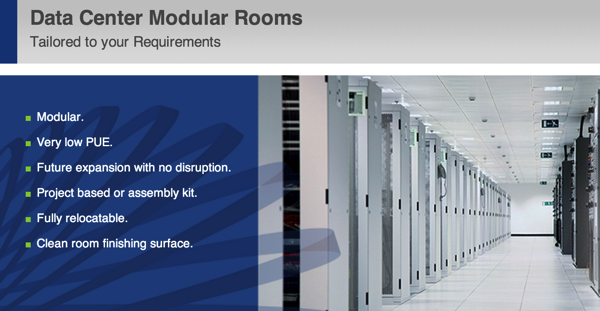
AST Modular offers a range of fully integrated modular data centers which provide unmatched flexibility, resiliency, and energy efficiency. Our offering includes containerized ISO datacenters, NON ISO modular datacenters and datacenter modular rooms. The three systems offer a scalable method of quickly developing data centre capacity, require minimal work on site and can be operational in a fraction of the time it takes for a traditional build. -
NewImage

5. Commscope Data Center Solutions

Discover data center solutions that evolve with your needs

Data centers are at the center of everything a business does, and modern applications are demanding more and more of them than ever before. IT operations are struggling to meet demand, manage costs and maximize uptime in the face of several key challenges:


Why Bloggers Fail, break the rules

I found this post on why bloggers fail, and the following are ways that I like to break all the rules the writer puts in his post.

There is no way I am like these type of bloggers.

What’s unfortunate is, in that group of people, I’m betting there’s someone just like you….

…Someone who believed pumping out good content will generate the leads and sales they need to run a profitable business.

…Someone who believed a journalist or Google would notice their hard work—and reward them with an endless supply of traffic that converts.

I am not a journalist, and spend little time pumping out content, and i don't try to make it good.  I try to make it interesting.  I think interesting content beats good content.

Traffic is not my goal.  In fact, I don't want to get too big, because it means I don't have targeted readers.

Most people who start blogs dream about their blog soaring to Everest-level subscriber numbers.

The results focus is shallow.

They’ll waste their first 3 months, and they’ll have NOTHING to show for it other than a bunch of social media logins, passwords, and the belief that “I’ll be ready to go, when I just finish this one thing…”

And here is the assumption that I disagree with.

They start their blog with good intentions, but fall off the beaten path because they waste time on pointless drivel that doesn’t deliver what they really want: more traffic… more leads… more sales.

I don't make any money on the traffic.  Well less than $1,000 a year in google adsense I don't consider money, it's loose change from not splurging at Starbucks.  I don't get any leads or sales.

So, why do I blog?  Writing my ideas down ingrains them in my memory.  My blog entries are all searchable.  The thing I didn't expect from this blog is many of my friends read regularly and we have fun chatting in person.

My main value from blogging is it enhances the conversations I have when I meet with my friends in person, talk on the phone, or exchange e-mail.

Name me a blogger who uses their blog to improve the quality of the communication with their friends.

Do you have a monk in your data center? Trappist Monks secrets to business success

I have been accused of living like a monk.  I used to live in my house without a TV, no stereo, with only one chair and glass table on the floor.  My current house is not like a monastery.  I still prefer silence instead of the stereo.  When I was 14 I started meditating.  And have been accused of having discussions with me is like arguing with a zen monk. :-)

On my trip to Iceland I finished the 

Business Secrets of the Trappist Monks: One CEO's Quest for Meaning and Authenticity

August Turak


There are many lessons in the book worth remembering.

The main theme is.

Service and selflessness are at the heart of the 1,500-year-old monastic tradition’s remarkable business success. It is an ancient though immensely relevant economic model that preserves what is positive and productive about capitalism while transcending its ethical limitations and internal contradictions. 

See how Journalism works, where the money comes from influences the content

One of the things I've had an interesting time trying to understand how the media works.  I use to work on print publishing technologies at Apple and Microsoft, and print is a continuous slide.  Going from print to online has been a painful transition for many.  

Matthew Ingram on PaidContent has a post that points out the difficulty of online journalism is can't survive without a wealthy benefactor or cat GIFS (random entertainment).  The meat of his point is here.

News has always been subsidized somehow

newspaper boxes

In the good old days, the journalism business was subsidized by all of the other things a newspaper containedapart from the news. This included classified ads, obviously, but also horoscopes, gardening columns, the comic page and other add-ons that had little or nothing to do with news or journalism. Gradually the internet has taken most of these pillars away, and left newspapers with just the hard news — in other words, the only thing no one wants to pay for.

Matthew points out Jeff Bezos acquisition of the Washington Post and other trade pubs.

Until it was acquired by Amazon CEO Jeff Bezos, the Washington Post was subsidized not just by the Graham family, but also by the Kaplan education business (until it began to fail as well). In Canada, the largest national paper — theGlobe and Mail — is owned by the Thomson family of Thomson Reuters fame, while the Toronto Star has been subsidized by both a family trust and the Harlequin romance business. The parent company of the Guardian in Britain subsidizes its journalism through a family trust but also through the ownership of the Auto Trader group of companies.

No different than understanding the background and history of a writer it is useful to understand what is subsidizing the news you are reading, because news in itself is not profitable.

Challenges of Doing Business in China, I wouldn't without Power and Money

I've had plenty of discussions on the subject of data center businesses going into China.  Scott Noteboom is the latest to make the announcement he'll go into emerging markets including China.  DCK covers the latest and Scott's statement he has the secret sauce to do business in China.

Noteboom believes he’s put together the connections and resources to make China more accessible. ”We believe that we will be the first provider to enable non-Chinese companies to smoothly deploy in China,” said Noteboom, who said he hopes to bring new data center technologies into China to realize exceptional efficiency and economics.

Noteboom isn;t supplying many details just yet. A key aspect of the plan will be site selection. Noteboom says LitBit hopes to identify the Asian equivalents of Quincy, Washington – previously unknown sites that provide exceptional economics and efficiency for data center operators.

My perspective on China is based on when I worked for Apple and Microsoft and would acquire power supplies and Simplified Chinese fonts. There are many meetings, negotiations and ongoing contract maintenance.  I've also known many people who have worked in China localizing Microsoft software or developing software in China.

Whenever someone in the data center industry says join me in working in China I say no thank you.

Here is a post that does a good job of explaining the challenges of doing business in China.  Five points are made.  #3 is the one that most don't know how to address.

Number three is kind of similar to number two. In China, there is always a story behind the story. There’s a person behind the person. It’s never what you see on the front end. It is partially related to cultural issues. For 5,000 years there has been this inside outside orientation to much of Chinese culture and as an outsider you are shown a certain view and as an insider you are shown a certain view. And there are various levels of being an insider or outsider. Again when you are trying to do business with a company or a person, you should find out where this person is from, where this company is from. What is their history? How did they become who they are today?  How did they get their money?  Who is behind them?  There is always someone sitting behind them, and not in a nefarious way. You are not talking to some puppet or shadow. There is just a level of complexity to Chinese business and to Chinese society that is important to take into account. We advise companies to never stop asking questions.

It will be interesting how LitBit does in China.  I helped out one friend who needed a resource that can address the above issue.  There aren't many.  You need a strategy and full time commitment to win in China, and even then you may lose.

Many people think China is new, but it is a country where Power and Money is in its DNA which by the way is not that much different than other countries.  It is just China has been at it for 5,000 years and it can be different than a Western approach.