I was telling one of my good friends who will tell me when I am wrong the story about how one of my other good friends described me as a Fiercely Independent Guy. She says, "remember, I am the one who said you are a gadfly. So, you can still be use the FIG acronym - Fiercely Independent Gadfly, instead of Fiercely Independent Guy. Now it was one thing to describe myself as the Fiercely Independent Guy, it is another to say I am Fiercely Independent Gadfly.
What is a Gadfly? Merriam's definition.
Definition of GADFLY
1 : any of various flies (as a horsefly, botfly, or warble fly) that bite or annoy livestock
2 : a person who stimulates or annoys especially by persistent criticism
It can hurt to be called a Gadfly.
These two people who categorized me as a gadfly could not be more different - one a Prince of the institutional church, almost 70 years old; the other a model for the Jesus follower of the future, recognized by many for his genius with people that the church routinely does not welcome. What they have in common is (a) they are 2 of the most powerful men in churchianity I know personally and (b) they took the time and effort to call me a gadfly. When both of them said this term, in very different settings, it was meant as a slur, a term of disparagement - and trust me, it hurt.
...
There is a funny thing about this slur - inside many institutions, it is a term to shut down new ideas, criticism or even challenges to power or sacred cow. Outside some of the most fallow institutions, these very characteristics are not a negative category or a way to stifle new life - they are, in fact, the core ethos the organizations strives to achieve. As is so often the case, a word meant to demean is actually a word of holiness, redeemed as part of our essence as beloved creatures made in God's image.
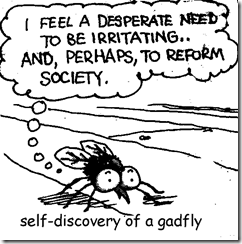
Do you know who is one of the most famous Gadfly is? Socrates.
The term "gadfly" (Ancient Greek: μυω̃ψ, myops)[1] was used by Plato in the Apology[2] to describe Socrates' relationship of uncomfortable goad to the Athenian political scene, which he compared to a slow and dimwitted horse. During his defense when on trial for his life, Socrates, according to Plato's writings, pointed out that dissent, like the gadfly, was easy to swat, but the cost to society of silencing individuals who were irritating could be very high. "If you kill a man like me, you will injure yourselves more than you will injure me," because his role was that of a gadfly, "to sting people and whip them into a fury, all in the service of truth." This may have been one of the earliest descriptions of pragmatic ethics.
The nice thing is with 30 years in the industry I've developed more patience and you can achieve results without being overzealous.
The Innovator's DNA is an example of a more tactful way to be a gadfly.
- Associating—drawing connections between questions, problems, or ideas from unrelated fields
- Questioning—posing queries that challenge common wisdom
- Observing—scrutinizing the behavior of customers, suppliers, and competitors to identify new ways of doing things
- Networking—meeting people with different ideas and perspectives
- Experimenting—constructing interactive experiences and provoking unorthodox responses to see what insights emerge
When engaged in consistently, these actions—questioning, observing,networking, and experimenting—triggered associational thinking to deliver new businesses, products, services, and/or processes. Most of us think creativity is an entirely cognitive skill; it all happens in the brain. A critical insight from our research is that one’s ability to generate innovative ideas is not merely a function of the mind, but also a function of behaviors. This is good news for us all because it means that if we change our behaviors, we can improve our creative impact. By completing an Innovator’s DNA assessment, you can better understand your personal innovation skill strengths and learn how to make them even better.
Was Socrates an Innovator, labeled as a Gadfly with critics hoping he would go away?
Socrates was in all things an innovator, in religion, in as much as he sought to eliminate from the theology of his contemporaries “those lies which poets tell “; in politics, in as much as he distrusted several institutions dear to Athenian democracy; in education, in as much as he waged war against authority, and in a certain sense made each man the measure of his own actions.
It is because Socrates was an innovator that we, who see in him the founder of philosophical inquiry, regard him as a great man; it was because Socrates was an innovator that old -fashioned Athenians, who saw’ in the new fangled culture the origin of all their recent distresses and disasters, regarded him as a great criminal.
The Gadfly label is applied as Socrates was a gadfly to a horse.
The term "gadfly" (Ancient Greek: μυω̃ψ, myops)[1] was used by Plato in the Apology[2] to describe Socrates' relationship of uncomfortable goad to the Athenian political scene, which he compared to a slow and dimwitted horse.
Isn't this the same as Mike Manos's talk on Chaos Monkeys, Donkeys and Innovation of Action?
In my talk I tried to focus on what I felt to be emerging camps at the conference. To the first, I placed a slide prominently featuring Eeyore (from Winnie the Pooh fame) and captured many of the quotes I had heard at the conference referring to how the Cloud, and new technologies were something to be mistrusted rather than an opportunity to help drive the conversation. I then stated that we as an industry were an industry of donkeys. That fact seems to be backed up by data. I have to admit, I was a bit nervous calling a room full of perhaps the most dedicated professionals in our industry a bunch of donkeys – but I always call it like I see it.
I contrasted this with those willing to evolve their thought forward, embrace that Innovation of Action by highlighting the Cloud example of Netflix. When Netflix moved heavily into the cloud they clearly wanted to evolve past the normal IT environment and build real resiliency into their product. They did so by creating a rogue process (on purpose) call the Chaos Monkey which randomly shut down processes and wreaked havoc in their environment. At first the Chaos Monkey was painful, but as they architected around those impacts their environments got stronger. This was no ordinary IT environment. This was something similar, but new. The Chaos Monkey creates Action, results in Action and on the whole moves the ball forward.
Interestingly after my talk I literally have dozens of people come up and admit they had been donkeys and offered to reconnect next year to demonstrate what they had done to evolve their operations.
So, if you are called a Gadfly, maybe the person is a Horse or a Donkey, and you are a Chaos Monkey, an Innovator.
" Criticism may not be agreeable, but it is necessary.
It fulfills the same function as pain in the human body. It calls attention to an unhealthy state of things."
- Winston Churchill"A society that gets rid of all its troublemakers goes downhill."
— Robert A. Heinlein